
Blog
Community Management: How to Run an Active Community
Community management that works: engagement rituals, moderation, conflict resolution, turning members into ambassadors, and the right tools.
Building communityA community does not appear on its own, and it does not keep itself alive either. Behind every active, lively community sits good community management: someone who starts conversations, welcomes new members and makes sure something happens. Whether you take that on yourself or have someone for it, the job is the same and decides between momentum and standstill.
The short answer: community management is the daily work on conversations. Replying, welcoming, moderating, giving prompts. Around five hours a month is enough if you pour them into fixed rituals instead of scattering them spontaneously.
This article shows what community management covers, which rituals keep engagement up, how to handle moderation and conflict, how to turn members into ambassadors, and which tools make the work easier.
What community management means: the role of the community manager
Community management is the ongoing work of keeping a community healthy, active and valuable. The community manager is host, moderator, bridge-builder and prompter in one person. It is not about constantly posting yourself but about creating a space where members contribute gladly and voluntarily and help each other along.
Concretely the role covers several tasks: starting conversations and keeping them going, welcoming new members, answering questions or routing them to the right person, guarding the tone and moderating when needed, and keeping an eye on mood and activity. Good community management is largely invisible: when it works, the community simply feels alive by itself.
Especially at the start you are usually that manager. That is even a good thing, because nobody shapes a community's culture as strongly as its founder in the first weeks. Later you can hand tasks to moderators or a small team.
The most important stance is that of a host, not a supervisor. A good host introduces people, gets them talking and makes sure everyone feels comfortable. Anyone who understands community management mainly as control creates a tense atmosphere in which nobody enjoys writing the first post. Warmth beats strictness almost every time.
Why most members never post
In 2006 Jakob Nielsen described the so-called 90-9-1 rule: in online communities about 1 percent of users contribute the bulk of the content, 9 percent participate occasionally and 90 percent only read (Nielsen Norman Group). At 500 members that means roughly 5 regular posters, 45 occasional ones and 450 silent readers.
This distribution is not a failure but the norm. It has two practical consequences. First: the silent 90 percent still get value from the community and therefore remain paying members. Second: your job is to keep the small active group and pull members out of the silent majority step by step, for instance with polls and questions that can be answered in a single sentence.
Engagement rituals: daily and weekly activities
Activity comes from reliability. When members know something happens regularly, they come back. Rituals give the community a rhythm and at the same time relieve you of constantly having to invent something new.
The rhythm that carries a community
Proven rituals on three time levels, with the effort they actually cost:
| Ritual | How often | Time needed | What it achieves |
|---|---|---|---|
| Reply to posts and welcome new members | daily | 10 to 15 minutes | nobody posts into the void |
| A fixed format: Monday check-in, question of the week or Friday wins thread | weekly | 20 minutes | a reliable anchor point in the week |
| Live call, Q&A session or a small challenge | monthly | 1 to 2 hours | a highlight members look forward to |
Figures from practice, not measurements. In total that is around five hours a month, less than most people spend on social media.
Responding is the strongest lever
The most important lever in community management is responding: every post that gets a reply encourages the next one. A community where posts run into the void falls silent quickly. So make sure nobody is left unanswered, especially early on.
Over time the work shifts. At first you supply most of the prompts yourself, later they increasingly come from members. Encourage that actively: ask open questions, invite members to share their experiences, and highlight good contributions. A community where members answer each other is the goal, because it carries itself and grows beyond your own capacity.
Vary the formats as well. A mix of questions, polls, shared wins, short tips and the occasional look behind the scenes keeps the community fresh. Posting the same thing forever tires your members. Watch which posts get particularly many reactions and do more of those rather than clinging rigidly to a fixed plan. More formats are collected in community gamification, and online community events describes the monthly highlights.
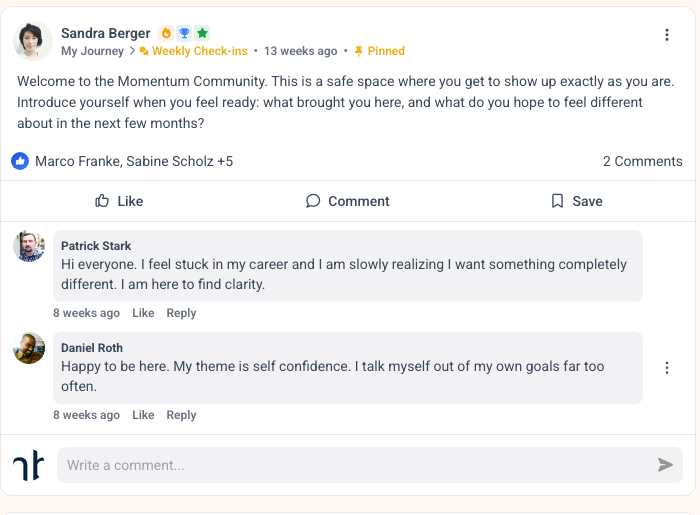
A post that gets answered is the difference between a community and a noticeboard.
Setting and enforcing moderation rules
Rules you can read in a minute
A community without rules tips over sooner or later. Clear, understandable rules create a safe space where members dare to contribute. Keep the rules simple and positively phrased: treat each other with respect, no spam, be helpful, stay on topic.
More important than setting them is enforcing them, fairly and consistently. Step in early when someone disturbs the tone, ideally in a friendly way and in private first. For repeated breaches you need clear consequences that you actually apply, because nothing undermines a community culture like rules that exist only on paper. Transparency helps: when members understand why a rule exists, they accept it more readily.
Make the rules visible on joining as well. A short welcome message explaining the tone and the key rules prevents most problems before they arise. How such a welcome is structured is shown in member onboarding. New members want to behave correctly, they just need to know what is wanted. Clear expectations from the start save you many interventions later.
A frequent special case is self-promotion. Define clearly whether and where members may share their own offers, for instance in a dedicated area or on a fixed weekday. A clear rule stops the community becoming an advertising space without banning legitimate conversation about members' own projects entirely.
If you are looking for wording: Reddit publishes its Moderator Code of Conduct openly. It is aimed at large public forums but works well as a template for which points rules should cover at all.
Conflict management in the community
Where people come together there is conflict. That is normal and not a sign of bad community management but an opportunity to show maturity. What counts is how you handle it.
A few ground rules help: respond quickly before a conflict escalates. Stay neutral and listen to both sides rather than taking sides prematurely. Move heated disputes into private, away from the public stage where people harden more easily. And clearly distinguish between a factual disagreement, which actually enriches a community, and a real rule breach, which needs a clear response. A confidently moderated conflict often strengthens trust in the community in the end.
For recurring or difficult cases it helps to record decisions briefly. A short internal note on who received which measure when and why creates consistency, especially when several moderators are involved. That way you treat similar cases similarly, which feels fair and protects you from accusations of arbitrariness.
Turning members into ambassadors
You cannot carry a growing community alone, and you do not have to. The most active and helpful members are your greatest asset. Involving them relieves you and strengthens their own attachment at the same time.
Here is how to turn members into ambassadors: recognise their contribution publicly, through praise, badges or a special status. Give them responsibility, for example as a moderator, topic host or mentor for newcomers. Bring them in for feedback and decisions so they feel like co-creators. Someone who feels seen and needed becomes an active advocate who welcomes new members, answers questions and carries the culture forward even when you are not around.
A loose ambassador or moderator programme gives that structure. Deliberately invite a few especially engaged members to take on more responsibility, and give them a clear frame and some recognition for it. Even a small group of reliable allies noticeably changes the dynamic of a community, because someone is always there to welcome, answer and hold the tone.
Turning members into ambassadors lowers churn along the way: reducing community churn shows why people leave and what helps.
Tools for community managers
Good community management gets considerably easier with the right tools. What matters are features that take over routine and provide overview: notifications about new posts, a member overview, moderation tools, automatic welcome messages and gamification that visibly rewards activity.
On an integrated platform these tools sit in one place instead of being scattered across several apps. You see who is active, welcome new members automatically, moderate directly, and keep a finger on the community's pulse with gamification and overviews. What that looks like is shown on the community page and the gamification page.
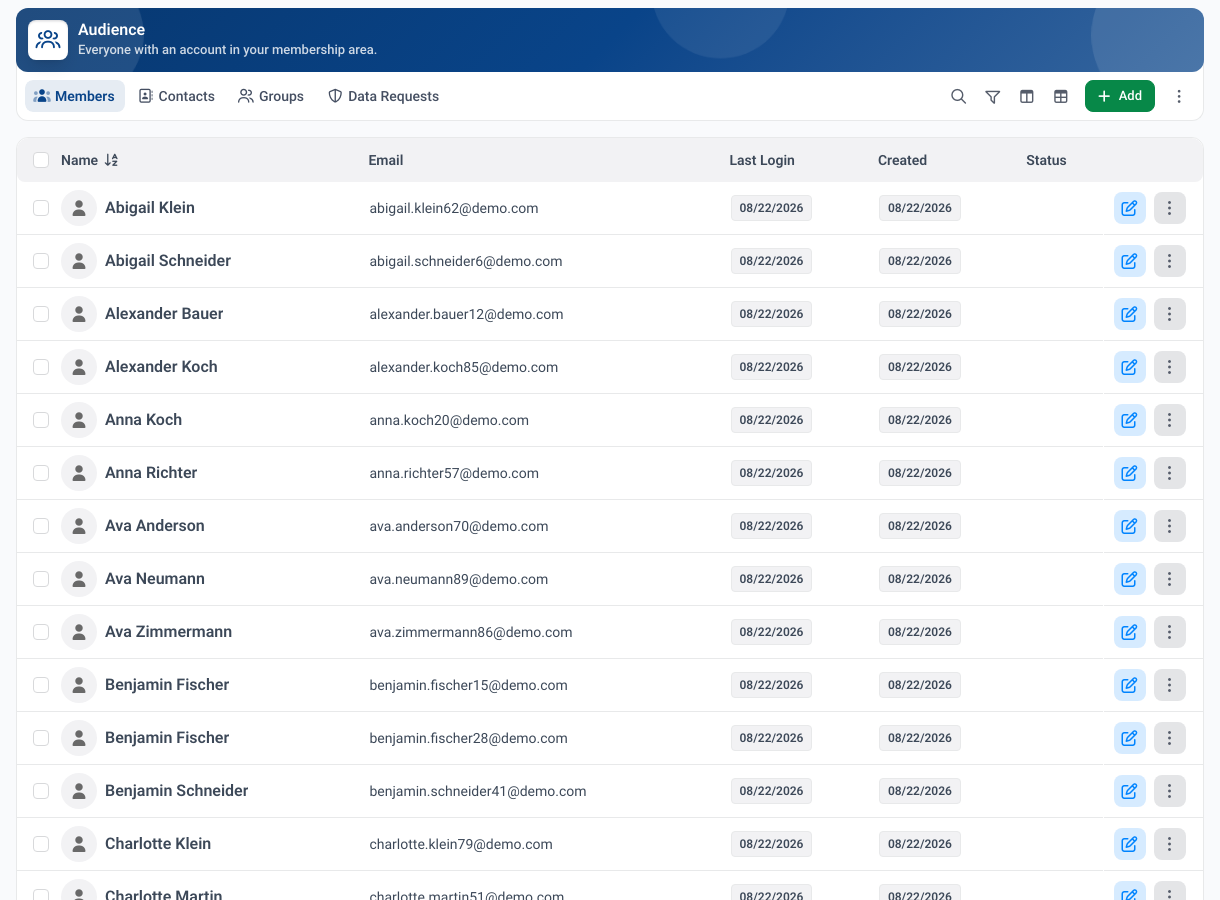
The member overview shows who is active and who has gone quiet.
The three metrics that are enough
Keep an eye on a few simple metrics. You do not need a dashboard for this, one look a week is enough:
| Metric | How to read it | What it tells you |
|---|---|---|
| Active members per week | member overview, sorted by last activity | whether the community lives or merely exists |
| Posts per week | count through the feed | whether prompts still come from you or already from members |
| Response time on questions | open posts without a reply | whether anyone is posting into the void |
These numbers show early whether energy is rising or fading, so you can counteract before a community quietly falls asleep.
Which platform brings these tools is compared in community platforms compared.
Manage your community efficiently with memberarea.io and focus on what counts: people and conversations. Try memberarea.io free and run community, courses and member management in one place.
Frequently asked questions
How much time does community management take? At the start a little every day, often 15 to 30 minutes for welcomes, replies and prompts. As the community grows and moderators get involved the load spreads, but your own presence stays consistently important.
Should I hire a dedicated community manager? Rarely necessary at the start, you are the best manager yourself. Once the community grows strongly and the daily tasks exceed your time, a dedicated community manager or a team of moderators pays off.
What is the most common mistake in community management? Inconsistency. Being very active and then disappearing for weeks breaks the rhythm. A little every day beats a lot occasionally.
How do I get silent members to participate? Lower the barrier. Ask simple questions anyone can answer, address people directly and warmly, and celebrate even small first contributions. Often all it takes is an inviting occasion to turn readers into participants.
Conclusion
Community management is the invisible work that keeps a community alive: starting conversations, creating reliable rituals, moderating fairly, resolving conflicts calmly and involving your best members. No single measure is complicated, but applied together and consistently they make the difference between a dead group and a living place.
Above all, community management is a marathon, not a sprint. The effect does not show on the first day but over weeks and months of reliable presence. Whoever stays with it builds something that needs less and less push from outside over time, because the community develops its own energy.
With the right tools more time is left for what matters, the people. Try memberarea.io free and manage your community, your courses and your members in a single place.



Ready to build your membership?
Try it free for 14 days. No credit card, no setup fees. Launch in minutes.
No credit card required · Cancel anytime