
Blog
How to Build a Paid Community That Earns Recurring Revenue
Build a paid community and earn from it: set the price, meet expectations, integrate Stripe and launch with a plan. The complete guide.
Building communityA free community grows quickly, a paid one earns money and often attracts the more committed members. Anyone building a paid community trades a little reach for predictable, recurring revenue and a group that genuinely wants to be there. Done right, a paid community is one of the most stable online business models there is.
This guide shows why paid communities work, how to find the right price, what members expect, how to implement it technically and how to launch successfully. By the end you will have a clear plan for your own paid community.
The short answer
A paid community comes together in four steps: set the price, define expectations, set up the technology with Stripe and a community platform, launch with a plan. Reach matters less here than a clear offer for the right people.
- Even a few dozen paying members carry a meaningful monthly revenue.
- Free grows faster; the paid premium area can be added later.
- Offer monthly and annual: the monthly option lowers the barrier, the annual one holds people longer.
- Against cancellations, reliably recurring value plus addressing inactive members early is what works.
In this guide: why it pays off · the right price · expectations · technology · launch · FAQ
Why building a paid community pays off
Charging money looks like a barrier at first but is often an advantage. A price filters: whoever pays is serious, participates more actively and stays longer. That is exactly what often makes a paid community livelier than a free one where many are only silent readers.
The economic advantages are clear:
- Recurring revenue: monthly or annual fees create predictable income instead of one-off sales.
- More engaged members: whoever pays also invests time and attention, which keeps activity up.
- High member value over time: a member who stays a year is worth considerably more than a one-time buyer.
- Scalable: with good moderation and culture a community carries hundreds of members without your effort growing at the same rate.
So anyone building a paid community today is not building a pure content product but a relationship people are willing to pay for regularly, as long as the value holds.
The difference to a free community is psychological too. In a free group the threshold to leave is low because nothing was invested. In a paid community members want to get the most out of their fee and participate accordingly. That is why many operators report that even a smaller paid community is livelier than a large free one.
Setting the right price for your community
Price on value, not on cost
The price is the most important and most uncomfortable decision. Too low looks cheap and leaves revenue on the table, too high puts people off. The key is to price on the value to members, not on your costs.
Ask yourself: what is the membership worth to a member? Does it save time, bring contacts, speed up a result? A monthly fee that pays for itself through a single valuable contact or one solved question feels fair. Common models range from a low monthly fee for broad audiences to higher prices for specialised expert communities.
| Billing | What it means for you | What it means for members | When it fits |
|---|---|---|---|
| Monthly | fast start, but earned again every month | low barrier, cancel any time | at the start and for broad audiences |
| Annual with a discount | cash flow up front, fewer cancellations | cheaper, but a commitment | once the community holds |
| Founder price, permanent | fast first members, permanently lower revenue per person | a reward for early trust | only for the first weeks |
The three billing models by effect. Most communities offer monthly and annual side by side.
A worked example for scale
Run the numbers instead of relying on a feeling: 80 members at €25 a month is €2,000 monthly revenue. If 5 percent cancel each month, that is 4 members you have to replace just to hold the €2,000. The 5 percent is an assumption and you only learn your real figure after a few months, but the maths shows why retention weighs more than growth.
A practical tip: start with a solid price and a founder discount for the first members rather than selling yourself too cheaply from the beginning. Lowering a price later is easy, raising it is harder. Also offer an annual option with a discount; it improves retention and your cash flow.
You can test the price over time. Raise it cautiously for new members and watch whether signups stay stable. Existing members usually keep their original price, which rewards their loyalty and avoids cancellations. That way you find, step by step, the price that best balances value and demand. The full derivation is in how to price an online course, the models in pricing models compared.
What members expect in a paid community
Whoever pays expects more than a chat room. A paid community has to deliver clear, recurring value, otherwise members cancel after a few months. These are the expectations to meet:
- Access and exchange: direct contact with you and with peers that is hard to get outside the community.
- Regular content: new prompts, calls or materials that justify the subscription month after month.
- Results: concrete help that moves members forward, not just pleasant company.
- Reliability: an active, well moderated environment where questions get answered and the tone is right.
The most common reason for cancelling is silence. A paid community lives on things happening. So plan fixed rituals and dates so members have an ongoing reason to stay and to feel the fee is well spent.
The first week decides
A strong first impression decides a great deal. Make sure new members find their way immediately in the first days: a clear welcome message, a first sensible step and a warm greeting. Someone who experiences real value in the first week is considerably more likely to still be there in month two and three. What such a start looks like is in member onboarding.
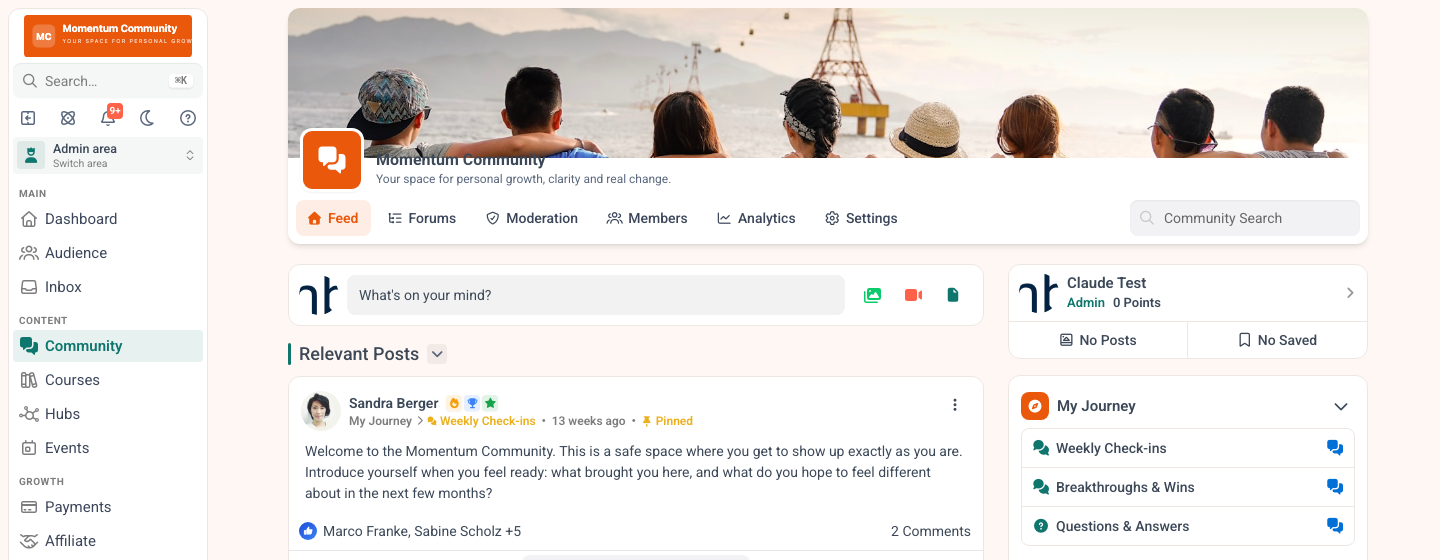
The community feed with pinned posts and forums by topic.
Technical setup: Stripe and a community platform
Access and payment belong together
Technically a paid community needs two things: reliable access control and clean payment processing. Members pay, receive access automatically, and on cancellation or a failed payment access is withdrawn automatically.
This is exactly where an integrated platform shows its value. When community, member management and payment via Stripe sit in one system, the whole chain runs automatically: purchase, granting access, recurring billing, invoice and withdrawal on cancellation, without you managing anything by hand. A makeshift setup of a separate community, an external payment tool and manual unlocking costs you time every week and is error-prone. How integrated subscriptions work is on the subscriptions page. The fee per payment comes from the payment provider: current rates are on Stripe's pricing page, and how to connect it cleanly is in setting up Stripe for your membership site.
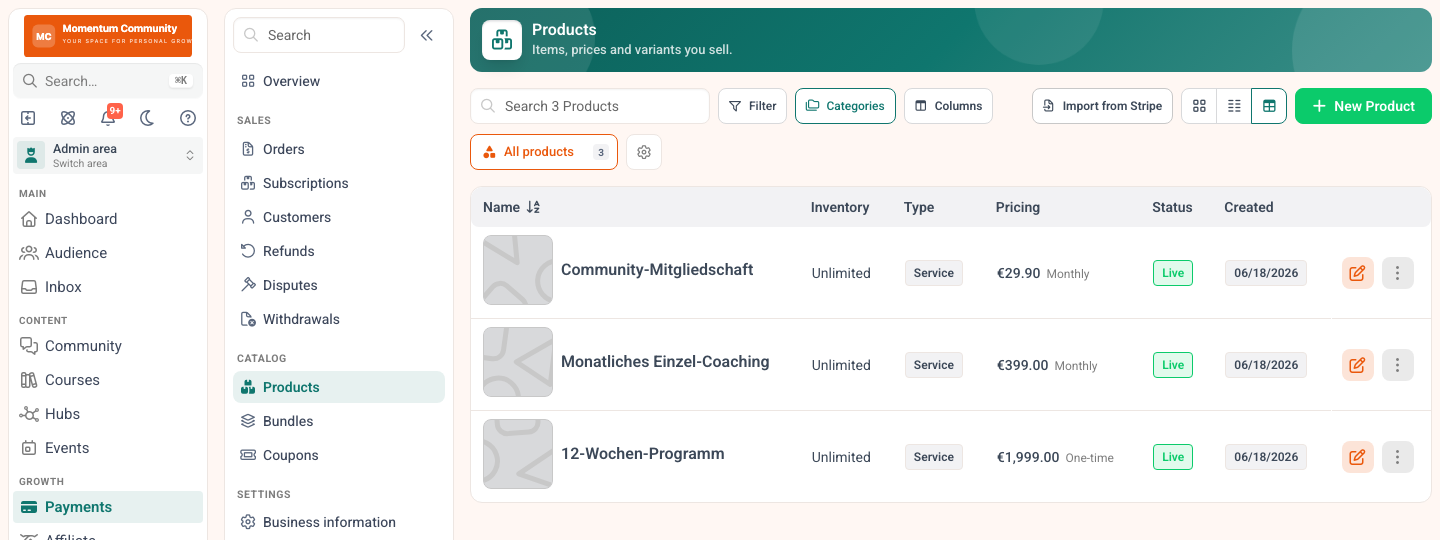
Monthly and annual subscriptions sit as separate products in the same catalogue, and switching is a plan change.
Failed payments cost you members otherwise
An often underrated detail is failed payments. Cards expire, direct debits fail, and without automatic retries and friendly reminders you lose members who actually wanted to stay. Good subscription management retries the payment automatically and informs the member in good time, so a technical problem does not become an unintended cancellation.
And when members leave anyway: reducing community churn sorts the reasons and what helps.
Launch strategy for your paid community
A planned launch beats a quiet start. Instead of simply opening the doors, you build anticipation and give the first members a reason to join right away:
- Build a waiting list. Collect prospects before the start so there is demand on opening day.
- Make a founder offer. A reduced price or a bonus for the first members rewards early decisions and creates an engaged starting group.
- Pre-fill with content. Make sure the community feels alive on day one, with first discussions and welcome content.
- Set a window. A limited signup phase provides the decisive push and avoids endless postponement.
After the launch you turn it into a permanently open offer or open in regular rounds. What matters is that the first members have a good experience, because they shape the culture and become your first advocates.
After the launch, do not forget ongoing member acquisition. A paid community lives on new members arriving continuously, because some will always drop out. Content that shows your expertise, recommendations from satisfied members and an affiliate programme create a steady inflow instead of relying on opening day alone.
Examples that work in practice
Paid communities work in very different shapes. Three typical models:
The expert mastermind. A small, higher-priced group with regular calls and direct access to the expert. Few members, a high fee, strong attachment.
The topic community with courses. A moderate monthly fee gives access to community, a course library and live events. The mix of content and exchange justifies the subscription long term.
The hobby or niche community. A low fee for a large, enthusiastic audience. Here the number of members makes the revenue, carried by a strong shared passion.
What they all share is that the recurring value is clear and members feel they are in the right place. That is exactly what makes a paid community viable.
What works in none of these models is trying to justify a paid community through exclusive content alone. Content is everywhere, often free. The real value lies in access, in the community and in the results that come from being in it together. Put that at the centre and you build a community members pay for as a place, not for individual posts.
Start your paid community on memberarea.io
On memberarea.io you build a paid community entirely in one platform: a community area with feed and discussions, paid memberships via Stripe, automatic access provisioning, courses, events and gamification, all under your brand and hosted in the EU. You neither connect a community to an external payment tool nor unlock access by hand.
Setting it up takes a few steps: create the membership with price and interval, design the community area, fill it with initial content and open it to your waiting list. More on community is on the community page, the plans on the pricing page.
Start your paid community on memberarea.io and turn your knowledge and your audience into recurring revenue. Try memberarea.io free and bring community, membership and payment together in one platform.
Frequently asked questions
Start free or paid? Both work. A free entry grows faster and can be converted into a paid premium area later. Anyone wanting revenue and commitment from the start goes straight to paid, ideally with a founder offer.
How many members do I need for it to be worth it? Fewer than you think. A few dozen paying members can carry a meaningful monthly revenue if the price matches the value offered.
How do I prevent cancellations? Deliver reliably recurring value, keep the community active and address inactive members early. Most cancellations grow out of silence and the feeling of no longer using what you pay for.
Bill monthly or annually? Ideally offer both. The monthly option lowers the entry barrier, the annual one holds longer and improves your cash flow. A discount on annual payment gently nudges many members into the model that is better for both sides.
Conclusion
Building a paid community means designing a paid relationship: charge a price that matches the value, meet your members' expectations with reliable content and exchange, implement the technology cleanly with integrated payment, and launch with a plan rather than quietly.
The best time to start is now, because every paid community begins with its first engaged members. Start free on memberarea.io and build a community that is not only alive but earns.



Ready to build your membership?
Try it free for 14 days. No credit card, no setup fees. Launch in minutes.
No credit card required · Cancel anytime