
Blog
How to Price Your Online Course: The Complete Framework
How to price your online course with a value-based framework: avoid underpricing, use anchoring and tiers, test with pre-sales and know when to raise.
MonetizationPricing is the single decision that most directly shapes how much your online course earns, yet most creators treat it as an afterthought. They pick a number that feels safe, undercharge for the transformation they deliver, and then wonder why the income does not match the effort. Learning how to price your online course is not about finding a magic figure. It is about understanding value, psychology and a few proven principles that let you charge what your course is truly worth.
This framework walks through why creators underprice, the difference between value-based and cost-based pricing, how to use anchoring and tiers, how to test your price with pre-sales, the choice between subscription and one-time payment, and when to raise your price.
Why most creators underprice their online course
Underpricing is the most common pricing mistake, and it usually comes from fear. Creators worry that a higher price will scare people away, so they aim low to feel safe. The irony is that a low price often does the opposite of what they hope. It signals low value, attracts less committed students and leaves money on the table that could have funded a better course.
There is also the curse of knowledge. Once something is easy for you, it feels like it should be cheap. But your students are not paying for the hours of content, they are paying for the result and the shortcut you provide. What took you years to learn, they get in weeks. That compression of time and effort is enormously valuable, and it has nothing to do with how easy the material feels to you now.
Knowing how to price your online course starts with letting go of this fear. A higher, fair price does not just earn more per sale. It also attracts students who take the course seriously, get better results and become the testimonials that sell the next round. Underpricing is rarely the safe choice it appears to be.
Value-based vs. cost-based pricing
The biggest shift in how to price your online course is moving from cost-based to value-based thinking. Cost-based pricing asks what the course cost you to make and adds a margin. Value-based pricing asks what the result is worth to the student. These two approaches often produce wildly different numbers, and the second is almost always higher.
Think about the transformation your course delivers. If it helps someone land clients, save hours every week or build a skill that changes their career, the value of that outcome dwarfs the cost of recording a few videos. Your price should reflect the destination you take students to, not the raw materials you used to build the road.
To price on value, get specific about the outcome. What does a student gain, and what is that worth to them in money, time or peace of mind? The clearer and bigger the result, the more you can justify charging. This is why two courses on the same topic can be priced very differently: one sells information, the other sells a transformation.
Price anchoring and tiers
Anchoring: the price next to it does the work
Price is never judged in isolation, it is judged in comparison. That is the power of anchoring. When people see a higher reference point first, your actual price feels more reasonable. You can anchor against the cost of the problem, the price of alternatives, or a premium tier of your own offer.
Three tiers, one obvious middle
Tiers are the most practical way to use this. Instead of one price, offer two or three packages, such as a basic, a complete and a premium version. Most people avoid the cheapest and the most expensive and choose the middle, which you can design to be your ideal offer. The premium tier does double duty: some buy it, and for everyone else it makes the middle option look like great value.
Keep tiers clear and distinct, usually no more than three, with each step adding obvious value. Done well, tiers move the decision from whether to buy toward which option to choose, which lifts both conversions and your average sale. You can set up tiers and prices on the pricing page.
What the price does to the work
The same revenue is a completely different business at different price points. Here is €20,000 in a year, three ways.
| Price per seat | Sales needed for €20,000 | What that means in practice | Support load |
|---|---|---|---|
| €500 | 40 | a small, committed cohort you can name | high per student, low in total |
| €200 | 100 | the most common shape for a first course | manageable with good onboarding |
| €50 | 400 | needs real reach or paid traffic | 400 people asking the same questions |
Plain arithmetic, not a benchmark. The point is that a low price does not only cut the margin, it multiplies the number of buyers you have to find and serve.
Testing your price with pre-sales
You do not have to guess your price and hope. The most reliable way to find out what people will pay is to ask them to pay before the course even exists. A pre-sale offers the course at a founding price to early buyers, and their response tells you more than any amount of theorizing.
A pre-sale does three things at once. It validates that people will actually pay your price, it funds the creation of the course, and it gives you a committed first cohort whose feedback shapes the final product. If the pre-sale sells well, you have proof. If it struggles, you have learned that cheaply, before investing months of work.
Set a real founding price and a genuine deadline, then watch the numbers. Strong demand is a signal you could go higher. Weak demand might mean the price, the offer or the message needs work. Either way, real money from real buyers beats opinions every time. The pre-sale is also step one in how to create an online course, for exactly that reason. A branded checkout makes running a clean pre-sale simple, as shown on the checkout page.
Subscription vs. one-time payment
One-off suits a finished result
How you charge matters as much as how much. A one-time payment suits a course with a clear beginning and end that delivers a specific result. It is simple to sell and easy for buyers to understand, with no ongoing commitment to weigh them down.
A subscription is a promise you keep paying for
A subscription suits ongoing value: a course library that keeps growing, a community, regular coaching or continuous updates. It builds predictable recurring revenue, but it also creates an obligation to keep delivering value every month so members stay. The right model depends on what you actually provide, not on which sounds more appealing.
Many creators combine the two, selling a course once and offering a subscription for an accompanying community or continued support. Whatever you choose, make sure the model matches the value, and remember you can offer payment plans to make a higher one-time price feel accessible. See how recurring billing works on the subscriptions page. What that model demands month after month is in recurring revenue for course creators.
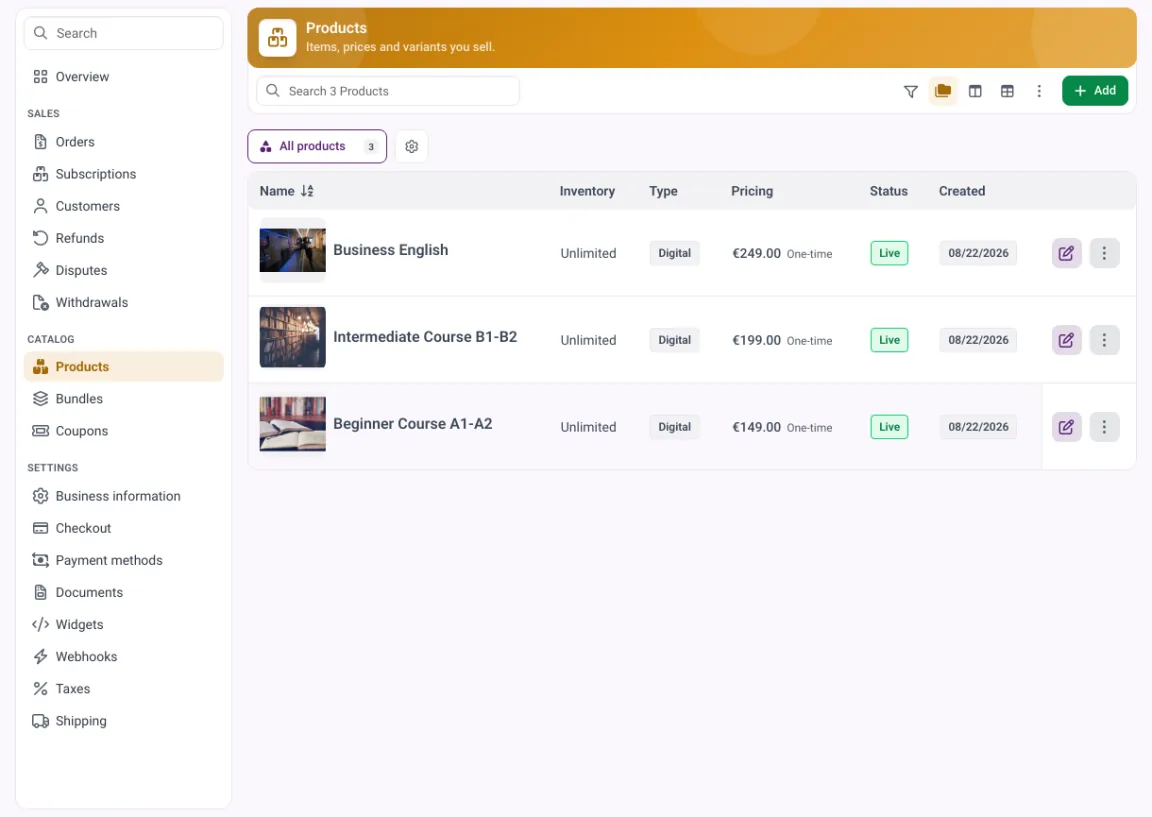
One-off price, instalment plan and subscription are three products in the same catalogue, so you can run them side by side.
The fee that quietly changes your price
Before you settle on a number, check what your platform takes from it. On a €200 course, a 7.5 percent platform fee is €15 per sale, or €1,500 across 100 sales, on top of the payment processor. That is the difference between a decent margin and a thin one, and it is invisible on the pricing page you set.
| Platform | Fee per sale | On a €200 course | Across 100 sales |
|---|---|---|---|
| memberarea.io | none | €0 | €0 |
| Kajabi Basic, external gateway | 2% | €4 | €400 |
| Podia Mover | 5% | €10 | €1,000 |
| Teachable Starter | 7.5% | €15 | €1,500 |
Fees as published on 6 September 2026, payment processor charges apply on top in every row. Our comparison of membership site software puts these against the monthly plans.
When to raise your price
Your first price is rarely your final one. As your course improves, your results stack up and your reputation grows, your price should grow with them. Many creators keep charging their launch price for years out of habit or fear, quietly leaving income behind.
Clear signals tell you it is time to raise. If your course sells easily with little resistance, if students consistently get great results, or if you have added meaningful content and bonuses, the price likely no longer reflects the value. Raising it can also strengthen the perception of quality, attracting more committed students rather than fewer.
Raise prices with intention. Announce an increase in advance, which often drives a wave of sales at the old price, and make sure the offer justifies the new number. Existing students can keep their original rate as a thank-you. Done right, a price increase rewards your growth and resets your course at a level that matches what it now delivers. If discounts are part of your plan instead, a coupon strategy that does not erode your price is the companion piece.
Set flexible pricing on memberarea.io
Knowing how to price your online course only helps if your platform lets you act on it. On memberarea.io you can set one-time prices, subscriptions, tiers, payment plans and founding-price pre-sales, all in the same place as your course and checkout. That means you can test, adjust and raise prices without wrestling with separate tools.
Because pricing, checkout and course access live together, every buyer gets the right access instantly, whichever option they choose, and you can see exactly which price converts best. Adding a second offer later is covered in upselling an online course. Learn more about building your course on the courses page and see the plans on the pricing page.
Set flexible pricing on memberarea.io and charge what your course is truly worth. Try memberarea.io for free and build your pricing where your course and checkout already live.
Frequently asked questions
How do I know if my price is too low? If almost no one hesitates and sales feel too easy, your price is probably below the value you deliver. A little resistance is healthy. Strong results and easy sales together are a clear sign you can charge more.
Should I match competitor prices? Not blindly. Competitor prices are a reference point, not a rule. Your course offers a different transformation, support and experience, so price on your value rather than copying others.
What if I already launched at a low price? You can raise it. Announce the increase, let existing students keep their rate, and make sure the new price reflects an improved offer. Most creators wish they had raised prices sooner.
Conclusion
Learning how to price your online course is about confidence and value, not guesswork. Stop underpricing out of fear, price on the transformation you deliver rather than your costs, use anchoring and tiers to frame the decision, test with pre-sales, choose the payment model that fits your value, and raise your price as your course grows.
Pick the price that reflects what your course is really worth and test it for real. Try memberarea.io for free and set flexible pricing where your course and checkout already live.



Ready to build your membership?
Try it free for 14 days. No credit card, no setup fees. Launch in minutes.
No credit card required · Cancel anytime