
Blog
Recurring Revenue for Course Creators: Models Explained
Recurring revenue for course creators: why one-time sales hold you back, which membership models work, how to price them and how to reduce churn.
MonetizationSelling a course feels great, until the launch ends and your income drops back to zero. Then you have to do it all again: find new buyers, run another launch, hope it lands. This feast-and-famine cycle is the hidden tax of one-time sales. Recurring revenue for course creators breaks the cycle by turning a single sale into an ongoing relationship that pays month after month, giving you the stability to actually build a business instead of chasing the next launch.
This guide explains why one-time sales hold you back, which membership models work for course creators, how to price a membership correctly, how to keep churn low, and how to combine one-time courses with recurring offers for the best of both worlds.
The short answer: a membership is worth building when you have something to deliver every month, not once. The two numbers that decide whether it works are how many members you add and what share of them leave, and the second one matters more than most creators expect.
Why recurring revenue matters for course creators
The core problem with one-time sales is that every month starts at zero. No matter how well last month went, this month you have to generate new revenue from scratch. That makes income unpredictable and planning almost impossible. You cannot confidently invest, hire help or take time off when you do not know what next month holds.
There is also a ceiling on growth. With one-time sales, more revenue means more launches, more promotion and more pressure, all of which depend on your constant effort. Your income is tied directly to your activity, so the moment you stop selling, the money stops too. That is a job, not a business that compounds.
Recurring revenue for course creators changes the math entirely. Instead of rebuilding each month, you start from a base of members who already pay you, and you grow on top of it. You know roughly what is coming in before the month begins. That predictability is not just comforting, it is what lets you make decisions like a real business rather than a series of one-off projects.
The number that caps your membership
Recurring revenue has a ceiling built into it, and the arithmetic is simple enough to do on a napkin. A membership stops growing when new members equal cancellations, which lands at roughly the number of new members per month divided by the monthly churn rate. Ten new members a month at 5 percent churn plateaus around 200 members. At 10 percent churn the same ten sign-ups plateau at 100. Halving churn does the same thing as doubling your marketing, and it is usually the cheaper of the two.
There is a compounding effect too. Each new member adds to the ones you already have rather than replacing last month's revenue. Over a year, a steady trickle of sign-ups builds into a base that can dwarf what any single launch produced, and it keeps working even in the months you are not actively selling.
Membership models for course creators
There is no single membership model, but a few work especially well for course creators. Most successful memberships combine elements of these:
- Content membership: Ongoing access to a growing library of courses and resources, with new material added regularly.
- Community membership: The value is the network, the discussion and the support among members, often around your courses.
- Cohort or coaching membership: Regular live calls, feedback and accountability layered on top of your content.
The model you choose should play to your strengths. If you love creating, a content membership fits. If you thrive on interaction, community or coaching is your core. The strongest memberships often blend all three: content as the foundation, community for stickiness and live access as the premium layer. See how a community works on the community page.
The key in every case is recurring value. A one-time course does not belong in a membership, but fresh content, live sessions and an active community do. Ask of every element: does this give members a reason to stay subscribed next month? If the answer is no, it is a one-time product, not a membership.
| Model | What members pay for | Your effort each month | Where churn comes from |
|---|---|---|---|
| Content | a library that keeps growing | producing new material | the month you publish nothing |
| Community | the people and the answers | moderating and prompting | a quiet feed |
| Cohort or coaching | your attention and feedback | the live hours themselves | your own capacity |
Most memberships that last blend all three: content as the floor, community for stickiness, live access as the premium tier.
Pricing a membership correctly
Pricing a membership differs from pricing a course. Instead of one larger payment, you set a recurring fee that is low enough for an easy yes and high enough to build a real business. The crucial concept is lifetime value: a member who stays many months is worth far more than the first payment suggests, so do not judge the price by month one alone.
Make the recurring value obvious. What does a member receive each month that justifies the fee? The clearer and more consistent that value, the easier the sale and the longer members stay. Offering an annual option at a small discount can also help, since it locks members in for longer and improves your cash flow and predictability.
What a member is actually worth
Lifetime value follows from churn. If 5 percent of members cancel each month, the average member stays about 20 months, because 1 divided by 0.05 is 20. At €39 a month that is €780 per member, before payment fees. The same member at 10 percent churn stays 10 months and is worth €390:
| Monthly churn | Average months a member stays | Lifetime value at €39 | Plateau with 10 sign-ups a month |
|---|---|---|---|
| 3 percent | 33 | €1,287 | 333 members |
| 5 percent | 20 | €780 | 200 members |
| 10 percent | 10 | €390 | 100 members |
Plain arithmetic on a steady churn rate, not a forecast. Real churn moves month to month and is higher in the first weeks than later, so treat this as the shape of the thing rather than a promise. Where to set the €39 in the first place is covered in how to price an online course.
Avoid the temptation to price too low just to fill seats. A bargain price often attracts less committed members who churn quickly and make the business unstable. A fair price for genuine value beats a cheap price that does not sustain you. You can set up tiers and recurring prices on the pricing page.
Reducing churn in subscription products
In any subscription, one number decides your fate: churn, the rate at which members cancel. Every month a member stays adds to your revenue with no new selling required, so keeping members is just as important as winning them. A membership with high churn is like a bucket with a hole, no matter how much you pour in, it never fills.
The strongest lever against churn is a great start. Members who reach a first win and feel welcome in the first days are far more likely to stay. Invest heavily in onboarding. Just as important is continuous value: when something new and useful arrives every month, there is no reason to leave. How recurring billing works in practice is shown on the subscriptions page.
The churn nobody chose
A share of your cancellations are not decisions at all: the card expired, the bank declined, the renewal simply failed. Stripe retries failed charges automatically and recommends its Smart Retries schedule, though you can define your own (Stripe on automated retries). Fixing that costs nothing but setup, which makes it the first thing to check before working on the harder, voluntary kind. The full dunning sequence is in Stripe for a membership site.
Make cancelling easy, on purpose
It is tempting to bury the cancel button. Beyond being a bad way to treat members, it is regulated: in the United States the FTC's Negative Option Rule targets recurring charges consumers did not intend and cancellation made harder than signing up (FTC Negative Option Rule). A pause option is the honest version of the same instinct, and it saves members a hard cancel would lose for good.
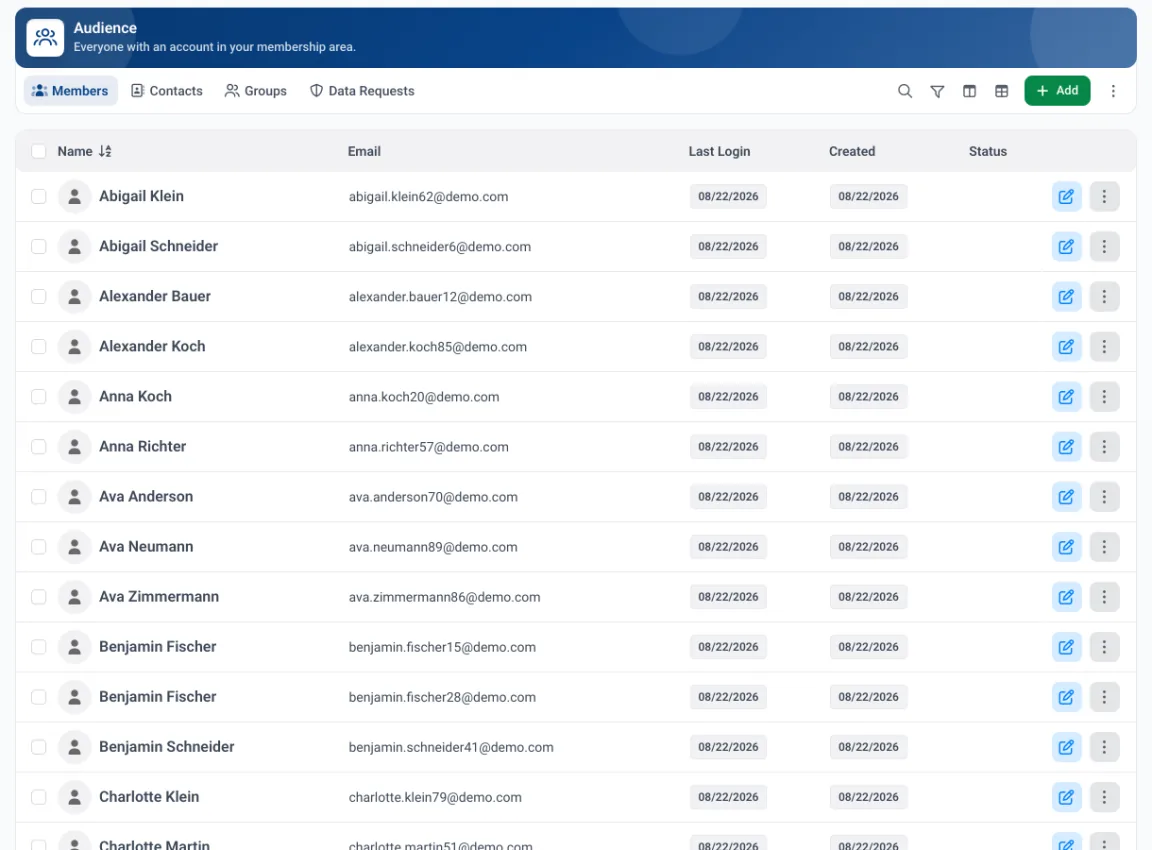
Cancellations are visible weeks earlier as inactivity. What to do about it is in reduce community churn, and the first days that decide it are in member onboarding best practices.
Watch when and why members leave, and ask them directly. Most cancellations cluster around a few fixable reasons. A living community is the strongest defense of all: members who have made connections rarely cancel, because leaving means walking away from people, not just a product. Offering a pause option instead of cancellation can also save members who would otherwise be gone for good.
Combining one-time courses with memberships
You do not have to choose between one-time courses and recurring revenue. The smartest course creators use both, and they reinforce each other. A one-time course can be the entry point that introduces someone to your work, and the membership is the natural next step for those who want ongoing support and community.
This combination also smooths your income. One-time course launches create spikes of cash and bring in new people, while the membership provides the steady baseline underneath. Launches feed the membership, and the membership funds the quieter months between launches. Together they are far more stable than either alone.
You can also use a one-time course as a tripwire into the membership. Someone buys a focused course, gets a quick win, and is then invited to continue inside the membership for ongoing support. The course pays for itself while quietly feeding your recurring base.
A common path is to start with one-time courses to build an audience and prove your value, then add a membership once you have happy students to invite. Your existing buyers are the easiest first members, because they already trust you. From there, recurring revenue for course creators becomes a layer you build on top of what already works, not a risky leap away from it.
Build your membership model on memberarea.io
To make recurring revenue work, your content, community, billing and access need to work together. On memberarea.io you build exactly that: a membership with recurring payments, a member area with your courses, an integrated community and automatic access control, all in one place without stitching tools together.
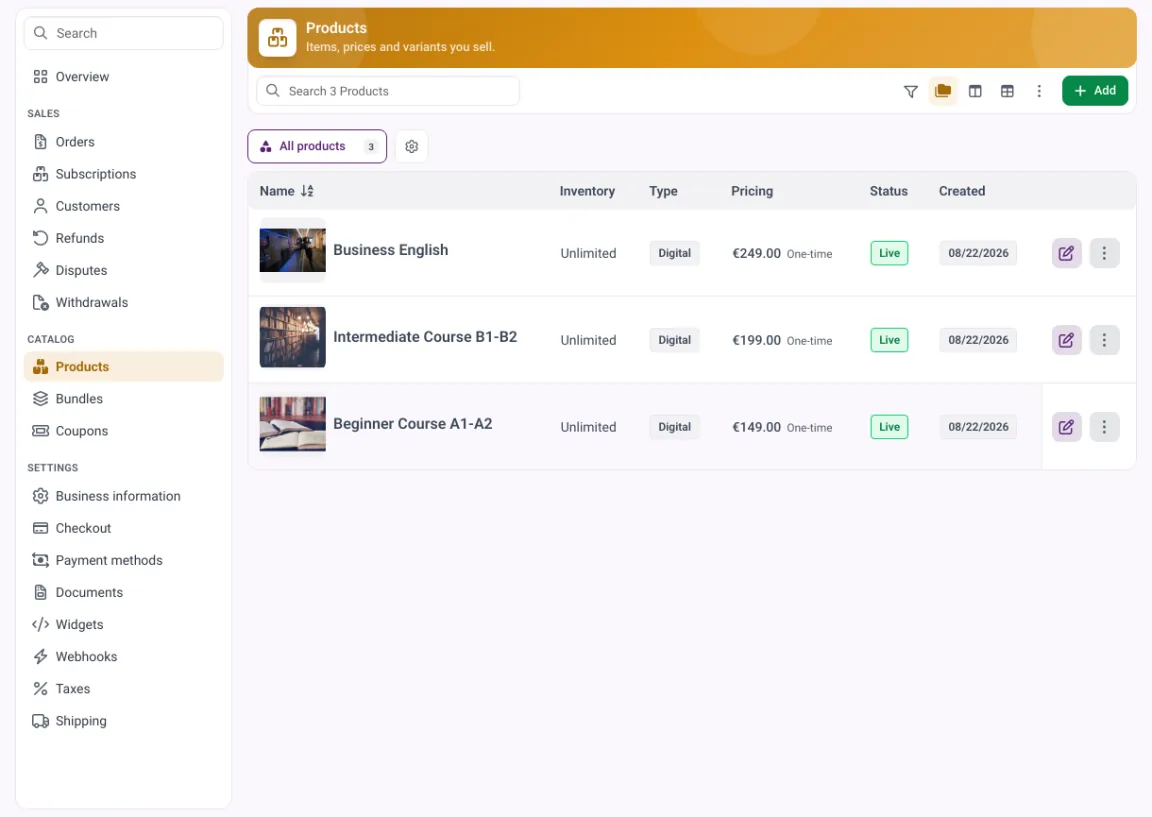
A monthly price, an annual price and a one-off course can sit side by side. What the market charges is compared in membership site software.
Because everything lives together, a prospect becomes a paying member with instant access, and access ends automatically when a member cancels. You can see how many members you have, who is active and where people drop off, so you can reduce churn with real data. Learn more about your courses on the courses page and see the plans on the pricing page.
Build your membership model on memberarea.io and trade the launch rollercoaster for steady, predictable income. Try memberarea.io for free and start your first membership where your courses and community already live.
Frequently asked questions
How many members do I need for stable income? Fewer than you think. Because the revenue recurs, even a modest group of loyal members forms a reliable base. Retention matters more than raw numbers, so focus on keeping the members you have.
Will a membership cannibalize my course sales? Usually not. They serve different needs and reinforce each other. One-time courses bring people in, the membership keeps the most engaged ones, and many buyers happily do both.
What is the hardest part of running a membership? Delivering value consistently so members stay. A membership is a relationship, not passive income. Creators who take that seriously build something remarkably stable.
Conclusion
Recurring revenue for course creators is the path from unpredictable launches to a real, stable business. Understand why one-time sales cap your growth, choose a membership model that fits your strengths, price it on recurring value, protect against churn with strong onboarding and community, and combine memberships with one-time courses for the best of both.
Remember that your first membership does not need to be elaborate. Even a small, well-run community with a steady stream of value can become a stable income that grows month after month.
Start with a simple membership and your existing students, then grow from there. Try memberarea.io for free and build your recurring revenue where your courses and community already live.



Ready to build your membership?
Try it free for 14 days. No credit card, no setup fees. Launch in minutes.
No credit card required · Cancel anytime