
Blog
Drip Course Content: Why Pacing Matters for Completion Rates
Drip course content releases lessons on a schedule to cut overwhelm and lift completion. Learn time-based vs progress-based drip and how to set it up.
Creating coursesImagine a student buys your course, downloads every video the first night, binges them over a weekend, and cancels three days later. This pattern quietly drains revenue from course creators everywhere. The fix is drip course content: instead of releasing everything at once, you deliver lessons on a planned schedule. Your course stays relevant for weeks rather than being used up in a single sitting.
In this guide you will learn what drip course content is, the difference between time-based and progress-based release, how dripping reduces overwhelm, how to set it up on your platform, and how real course creators use it. By the end you can plan your first drip schedule with confidence.
The short answer: drip when the course promises a transformation over time, keep full access when it is a reference library people search. Pick time-based release for a shared rhythm, progress-based when lessons build on each other, and never launch without four to six units already finished.
What drip course content is and how it works
Drip course content means releasing lessons, modules, or bonuses gradually instead of unlocking the whole course on day one. The term comes from a slow, steady drip: your knowledge reaches students in digestible portions rather than flooding them all at once.
Compared with a course where everything is open from the start, dripping offers several concrete advantages:
- Higher completion rates: Students who receive one manageable unit at a time stay engaged longer than those facing an overwhelming wall of material.
- Fewer refunds: When a course cannot be consumed in a single weekend, buyers are far less likely to ask for their money back.
- Predictable retention for memberships: In a monthly model, each new release gives members a concrete reason to keep their subscription active.
- Better learning outcomes: Gaps between lessons give students time to practice and apply, not just consume.
Drip course content makes the most sense for transformation-based courses, such as an eight-week fitness challenge or a structured language program. For a pure reference library that buyers want to search on demand, immediate full access can be the better choice. The honest question is not whether dripping is good in general, but whether your content benefits from a rhythm.
Time-based vs. progress-based drip
When you set up drip course content, you face one fundamental choice: should lessons unlock on a fixed schedule, or based on the student's progress? Both models have their place, and the choice shapes the whole learning experience.
Time-based drip is tied to the enrollment date. Module one is available immediately, module two after seven days, module three after fourteen, and so on. This suits courses with a clear weekly rhythm, challenges, and groups that start together. The advantage: everyone moves at roughly the same pace, which makes community discussion and live sessions far easier.
Progress-based drip unlocks the next lesson only once the previous one is completed or a quiz is passed. This fits sequential material where no one should skip a chapter. The advantage: each student learns at their own speed without losing the thread, and weaker foundations are not simply skipped.
In practice, many creators combine the two. A proven setup releases the main modules on a time-based schedule but requires completing the previous lesson within a module. That way you get both a motivating weekly rhythm and a clean sequence in a single course.
| Time-based | Progress-based | Both combined | |
|---|---|---|---|
| Unlock rule | days after joining | previous lesson or quiz completed | modules by date, lessons in order |
| Fits | challenges and cohorts | sequential material | most structured courses |
| Effect on community | everyone at the same point, discussion is easy | members spread out, discussion is harder | a rough shared week, individual pace inside it |
| Main risk | fast learners wait | one stuck lesson blocks everything | more to explain up front |
If you run live sessions, time-based wins on that one point alone: it is the only model where everyone arrives having seen the same material.
How drip content reduces overwhelm
Overwhelm is one of the biggest reasons students quit. Faced with forty hours of material on day one, many feel they will never finish and so never truly start. Drip course content removes that pressure by showing only what is relevant right now.
Anticipation does the work that access cannot
There is simple psychology at work. People value what they anticipate and work toward. A lesson that appears next week carries a weight that a folder of a hundred instantly available videos never will. At the same time, the paced rhythm protects against the paralysis that makes so many buyers set a course aside on the first login and never return. Dripping replaces that pressure with a clear, achievable next step.
This is also why pacing lifts completion rates so reliably. A student who only ever sees the current unit experiences a sequence of small, finishable wins instead of one intimidating mountain. Each completed step builds the momentum that carries them to the end.
Setting up drip on your platform
A membership site lives on members paying month after month, so for memberships drip is often the core of the model rather than a nice extra. Whatever your format, a few steps make setup smooth:
- Choose the rhythm. Weekly, every two weeks, or monthly. The cadence should match your production capacity, because nothing harms a membership more than a promised release that fails to appear.
- Build a buffer. Keep at least four to six units in reserve before you launch, so you are not under pressure if one week slips.
- Define the starting point. Decide whether new members begin at unit one (time-based from signup) or whether everyone sees the same calendar content. The former is fairer to late buyers, the latter makes shared live sessions easier.
- Announce what is coming. A visible note about the next release builds anticipation and noticeably lowers cancellations.
Pick a cadence you can survive
| Cadence | Units needed for a 12 week course | Buffer to have ready before launch | The honest question |
|---|---|---|---|
| Weekly | 12 | 4 to 6, so 4 to 6 weeks of air | can you finish one unit a week for three months? |
| Every two weeks | 6 | 3, so six weeks of air | is each unit big enough to be worth the wait? |
| Monthly | 3 | 2, so two months of air | what keeps members engaged between releases? |
The buffer is the part people skip and then regret. A missed release in a subscription costs more than a late newsletter, because members notice exactly what they paid for.
A note on refunds and the withdrawal period
The article above claims dripping reduces refunds, and it is worth being precise about why. In the EU consumers have a withdrawal right of 14 days from the conclusion of the contract, implemented in Germany in section 355 of the Civil Code (§ 355 BGB), and for digital content that right can lapse early only under the specific conditions set out in section 356 (§ 356 BGB). What dripping changes is not the law, it is the situation: during those first two weeks the buyer has seen only the first unit or two, so there is nothing to download in full and walk away with. Treat that as a practical effect, not legal advice, and check your own obligations with a qualified person.
Handle already-unlocked content with care as well: once a lesson is open, keep it open, so no one feels they are losing access. An integrated community amplifies the effect, because members discuss each new release and keep one another motivated. How that space is built is in how to build an online community.
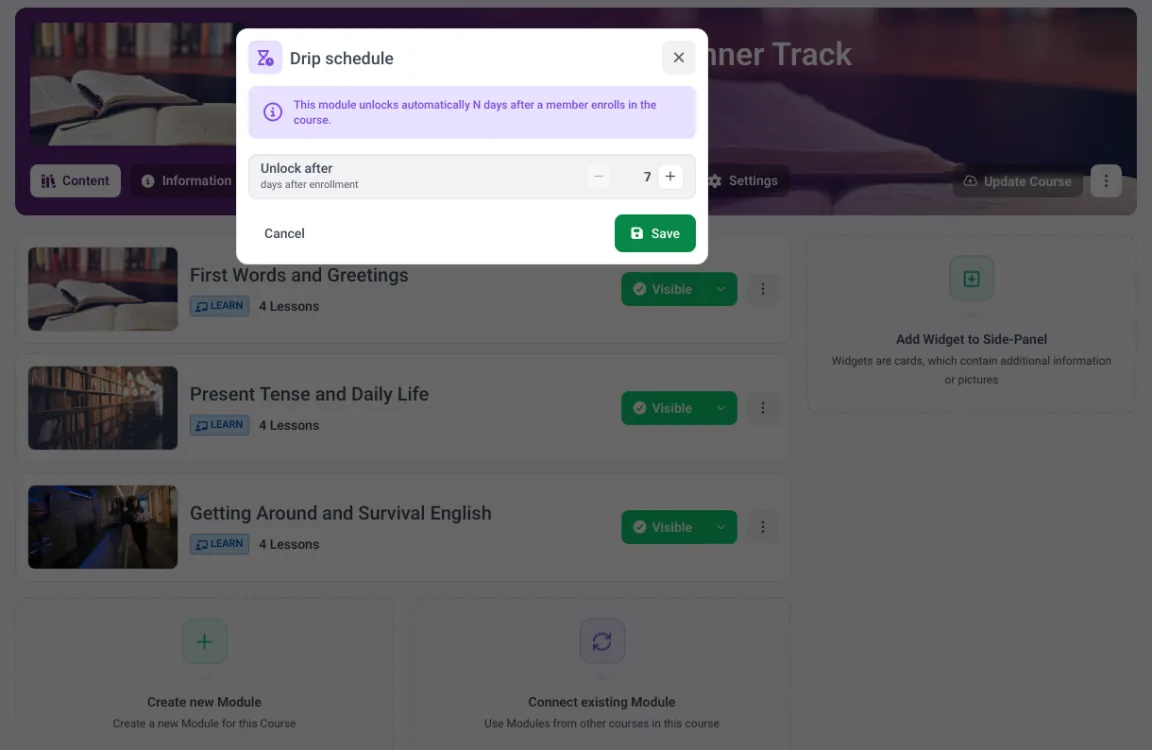
One number per module is the whole configuration. The course structure it sits on is covered in how to create an online course.
Real examples from course creators
Drip course content looks different depending on the business model. Three examples show the range:
The eight-week fitness challenge. Each week unlocks a new training plan and a motivation video, strictly time-based from the join date. Participants cannot jump ahead, which prevents overload and keeps the tension alive across the full eight weeks.
The sequential language course. Here release is progress-based. The next unit opens only once the vocabulary test is passed, so every lesson builds cleanly on the last and no one skips the foundations they will need later.
The monthly expert membership. On the first of each month a new deep-dive module appears, paired with a live session. The recurring promise of fresh content justifies the monthly fee and creates stable, predictable retention.
All three share one thing: the timing is part of the product promise, not just a technical setting in the background. In the third case the release schedule is the membership, which is the model examined in recurring revenue for course creators. That is what makes good drip course content work.
Set up drip content on memberarea.io
On memberarea.io you configure drip course content directly in the course builder, with no extra tool and no code. For each module or lesson you set an unlock rule: either a number of days after the member joins for the time-based model, or completion of the previous lesson for the progress-based model. You can mix both rules in the same course.
Here is how it works:
- Open your course in the editor and select the module or lesson you want to release on a delay.
- Enable the unlock rule and choose between time-based (days after signup) and progress-based (after the previous unit is completed).
- Optionally add an automatic notification so members get an email when new content unlocks.
- Publish the course and test the flow with a demo account to check the rhythm from the member's side.
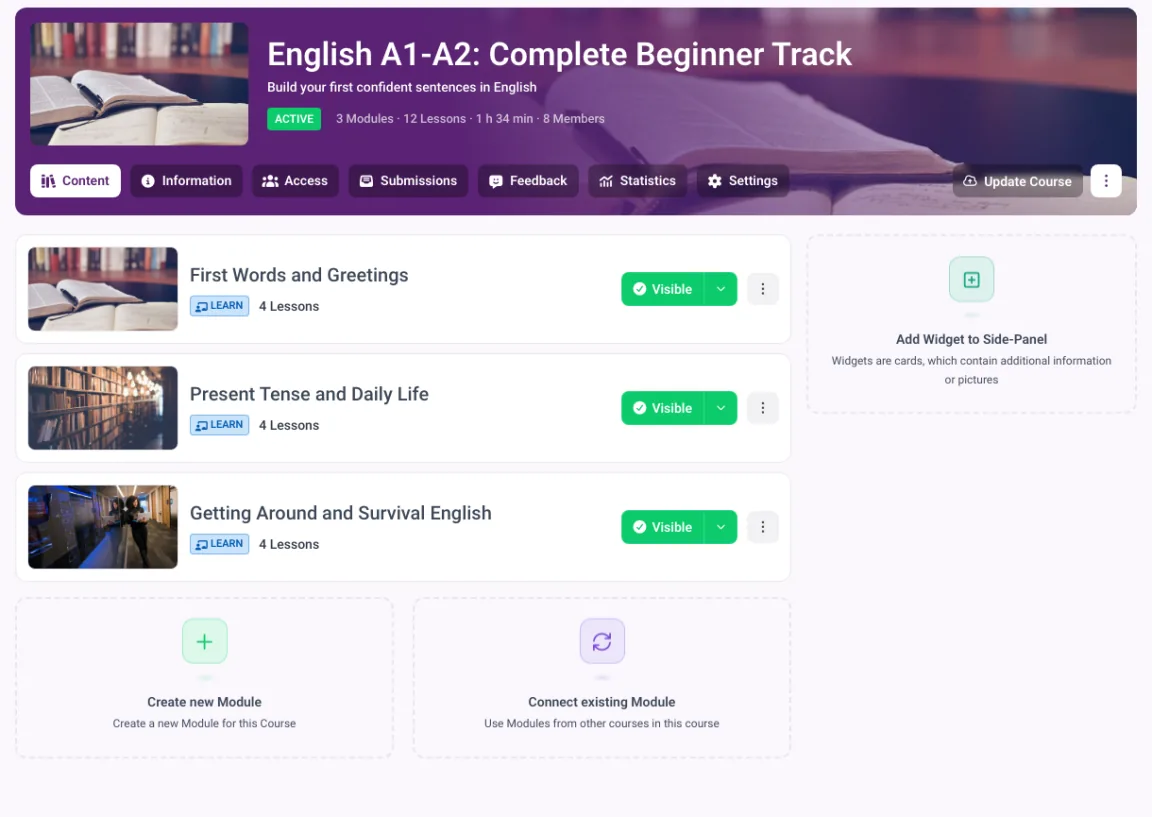
The drip rule sits on the module, so the structure you build first decides the rhythm you can offer.
Because courses, community and automations all live in one platform on memberarea.io, these pieces work together: access is granted automatically after purchase, the first unit is there immediately, and each one after follows on schedule. You can see all course features on the courses page, and pricing on the pricing page. Whether the pacing is actually working shows up in the numbers described in online course completion rates, and the emails that announce each release in email automation for a membership site.
Set up drip content on memberarea.io in minutes and turn a course that gets consumed in a weekend into an experience that guides your members for weeks. Start free and build your course, drip schedule and community in one platform.
Common drip content mistakes
A few mistakes show up again and again. First, a pace that is too fast: releasing something new every other day overwhelms members just as much as full access and wastes the real benefit. Second, an empty buffer: starting with no reserve quickly leads to delays, and a missing release weighs more heavily in a subscription than a late newsletter. Third, poor communication: when members do not know when the next unit arrives, uncertainty replaces anticipation, and a short announcement per release solves that almost entirely. A fourth, often overlooked mistake is forcing drip where it does not belong, such as on a reference library buyers want to search freely. Always check whether your content truly benefits from a rhythm before you pace it.
Frequently asked questions
When is drip content worth it? As soon as your course has several units and tracks a result over time, it almost always benefits from a rhythm. Even a single course with four modules is a good starting point for drip course content.
Does drip content frustrate buyers who want everything now? Not if you communicate the schedule clearly before purchase. Members who expect a guided path experience the pacing as a benefit, not a restriction.
Can I add drip content to an existing course? Yes. You can switch a live course to scheduled release at any time, but tell existing members first so no one is surprised to lose access to modules that have not unlocked yet.
Conclusion
Drip course content turns a course that gets used up in a weekend into an experience that guides your members for weeks. Choose deliberately between time-based and progress-based release or combine the two, plan a buffer of content, and announce every unlock. Completion rates and retention then rise almost on their own.
If you want to set up drip content without stitching together separate tools, memberarea.io has every building block in one place. Start free on memberarea.io and turn your material into a course that lasts.



Ready to build your membership?
Try it free for 14 days. No credit card, no setup fees. Launch in minutes.
No credit card required · Cancel anytime