
Blog
Content Marketing for Online Courses: What Actually Works
Content marketing for your online course: winning students organically without ads. Formats, an editorial plan, the path to the course and the best channels.
Getting membersPaid advertising brings clicks quickly, but it stops working the moment you stop paying. Content marketing, by contrast, builds an asset: content that attracts new prospects month after month long after you created it. For online course providers, content marketing is the most sustainable way to win students organically. Anyone who takes content marketing for their online course seriously builds a stream of prospects that does not dry up when the ad budget ends.
This article shows why content beats paid advertising, which formats convert best, how to set up an editorial plan, how content becomes course sales, and which channels are worth it, so your knowledge reliably turns into students.
The short answer: write about the questions your future buyers are already asking today, offer something free in every post in exchange for the email address, and stay with one channel for a year. Content works late but lastingly.
Content marketing vs paid advertising for your online course
Both routes bring prospects, but in very different ways. Paid advertising is like renting: as long as you pay, visitors come; the moment you stop, it ends. Content marketing is like owning: building takes longer, but afterwards it is yours and works for you permanently.
Content marketing for an online course has three big advantages: it is cheaper long term, because a good article or video brings visitors for years. It builds trust, because you show knowledge rather than only advertising. And it attracts exactly the right people, because they are actively searching for your topic. The drawback is patience: content does not work overnight. But whoever sticks with it builds a lead paid advertising cannot catch.
Another advantage of content is that it works around the clock. While you sleep, someone finds your article through a search, gets to know you and signs up. Paid advertising only does that while budget flows; good content does it permanently and without ongoing cost.
The combination is strongest. Content builds the foundation and the trust, paid advertising can accelerate deliberately later once you know your offer sells. Starting with content also teaches you exactly which topics and messages pull, making any later advertising more effective.
What a single article delivers over time
The maths explains why content feels like wasted time and still is not. A post that reliably brings 100 visitors a month after six months delivers around 3,000 visits over the following two and a half years. At a 15 percent signup rate that is 450 addresses from a single article you wrote once. Twelve such articles a year and you have a machine that keeps running even when you publish nothing for two months. The rates are assumptions; the pattern is the point: paid advertising ends with the budget, an article does not.
Content formats with the best conversion rates
Not all content sells equally well. Some formats attract many visitors, others few but exactly the right ones. For course providers these work particularly well:
- Guides and how-tos: they solve a concrete problem and attract people who need a course for exactly that.
- Comparisons and lists: content like the best routes to an outcome ranks well and leads naturally to your offer.
- Case studies and results: real successes show your method works and convince the undecided.
- Free mini lessons: a taste of your course is the most direct bridge from content to purchase.
The key is creating content close to your course topic. Anyone selling a photography course wins more suitable prospects with photo tutorials than with general creativity tips. The closer the content sits to the offer, the higher the conversion.
A clever lever is repurposing. From one good core piece you make several formats: a blog article becomes a video, the video becomes short clips, the core statement becomes a newsletter. That way you serve several channels without starting from zero each time, and your best knowledge reaches more people.
Do not forget search-strong content either. Topics people actively google bring free traffic for years. Research the questions around your course topic and answer them more thoroughly than anyone else. Such an article becomes a reliable gateway for exactly the people who need your course.
| Format | Who finds it | Proximity to a purchase |
|---|---|---|
| Guide or how-to | whoever has the problem right now | medium, they are looking for a solution |
| Comparison or list | whoever is choosing between options | high, the decision is pending |
| Case study with a result | whoever doubts it works | high, it clears objections |
| Free mini lesson | whoever wants to know your style | highest, it is the course in miniature |
| Foundational article on the topic | whoever is just starting | low, but it brings the most visitors |
The last row is why you need both: foundations bring reach, comparisons and case studies bring buyers. Anyone writing only foundations has many readers and little revenue.
Building an editorial plan for course creators
Content marketing rarely fails on ideas but on consistency. A simple editorial plan ensures you publish regularly instead of working in bursts and then falling silent.
Here is how to build one: collect your audience's most frequent questions, because each one is a content topic. Order them by proximity to your course and set a manageable rhythm, such as one post a week. Plan a few weeks ahead so you never have to improvise under pressure. More important than frequency is reliability: better one good post every week than five in a week and then nothing for a month.
Produce in batches
Produce in batches where possible. Preparing several posts in one day gets you into flow more easily and creates a buffer that bridges bad weeks. A filled buffer is the best protection against the silence that ends most content efforts prematurely.
Reuse what works. A post that performed well can be updated, deepened or converted into another format after some time. You do not have to invent something new constantly; often it is enough to refresh the best regularly and share it again.
What Google expects from your content
Before investing in tricks: Google describes its requirements itself and fairly plainly. The guideline is called "Creating helpful, reliable, people-first content", meaning content for people rather than search engines, and it points to E-E-A-T, meaning experience, expertise, authoritativeness and trustworthiness as quality markers (Google Search Central). For a course provider that is good news: experience is exactly what you have, and it shows in concrete examples, your own numbers and cases from practice, not in keyword density.
From content to course: the natural path
Content alone does not sell, it has to lead to the course. The path there should feel natural, not bolted on. Every piece solves a small problem and at the same time creates curiosity about the complete solution your course offers.
Concretely that works through two bridges. First the lead magnet: offer something free in every post in exchange for the email address, then you guide prospects into a sequence leading to the course. Second the direct pointer: refer clearly to your matching course at the end of every piece. That way a reader who trusts you becomes a student step by step.
The dose matters. Selling in every sentence loses trust; never mentioning your offer gives away sales. The rule of thumb: deliver value predominantly and mention your offer regularly but discreetly. People buy from those who helped them first.
Remember that trust takes time. Very few buy on first contact. That is exactly what the email list is for: it holds the connection until the right moment comes. Without that bridge you lose most prospects as soon as they have read your content.
Every post needs a destination: the page with the free offer. What it looks like is in the sales page for your online course, what happens behind it in email marketing for online courses.
Content channels: YouTube, blog, LinkedIn and newsletter
You do not have to be everywhere at once. Deliberately choose the one or two channels that fit your topic, your audience and your personal strength:
- Blog and SEO: ideal for knowledge people actively search for. An article that ranks brings visitors for years.
- YouTube: strong for visual and practical topics, and videos are searched there just like in a search engine.
- LinkedIn: valuable for professional and B2B topics, with high organic reach for expert content.
- Newsletter: the channel you own. This is where you lead all others, and from here you sell best.
A proven pattern is choosing one main channel you are genuinely good at and steering all content into the newsletter in the end. That builds reach on one platform and converts it into a channel you own, one that works independently of an algorithm.
More important than the choice of channel is sticking with it. Every channel rewards consistency over months, not individual spikes. Better to deliver reliably on one platform for a year than to give up on three after a few weeks. Reach is compound interest that above all requires patience.
| Channel | How long a post works | Effort per post | Who owns the reach |
|---|---|---|---|
| Blog and search | years | high, half a day to a day | you, the site is yours |
| YouTube | months to years | high, recording and editing | the platform |
| LinkedIn and social | days | low, half an hour | the platform |
| Newsletter | the moment it is opened | medium | you, the addresses are yours |
The last two columns together make the strategy: one channel with long-lasting effect for visibility, the newsletter as the destination for everything. How both fit into one flow is shown in sales funnels for coaches.
In the end everything leads to the offer. How to sell it is in selling your online course, what a free entry looks like in the free course strategy.
Start with your course platform on memberarea.io
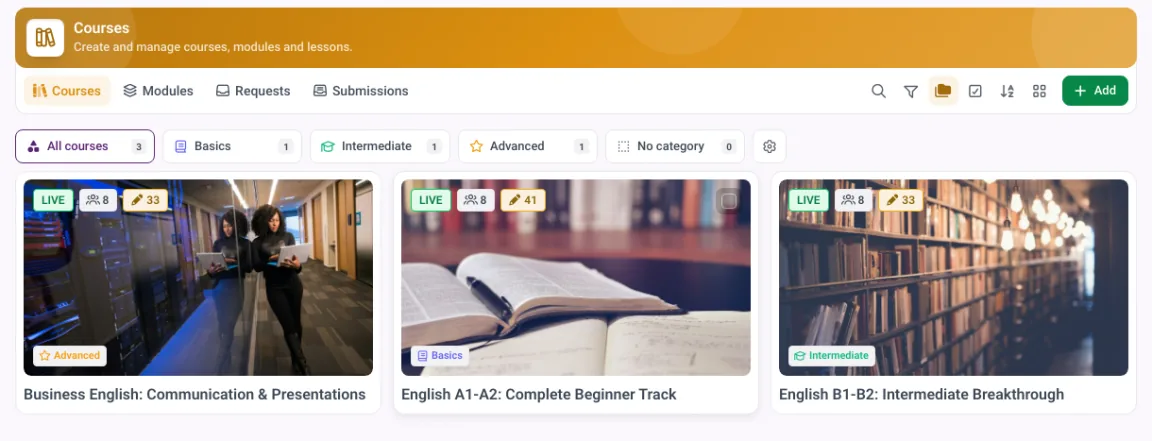
Content marketing reaches its full effect when the path from content to course is frictionless. On memberarea.io, courses, lead magnets, email marketing and checkout sit in one platform. A reader picks up your lead magnet, runs automatically into a sequence, buys the course and gets access immediately, with no tools to connect.
That way your content is not an end in itself but an engine reliably producing course sales. More on course features is on the courses page, on email marketing on the email marketing page, and the plans on the pricing page.
Conveniently, you see the whole path in one place: which content brings signups, which sequence sells and which course feeds from it. That end-to-end view shows which content topic really pays off, and that is exactly where you then produce more.
Start with your course platform on memberarea.io and turn your content into paying students. Try memberarea.io free and bring content, email and course into one platform.
Frequently asked questions
How long does content marketing take to work? Usually several months. SEO and organic reach need a run-up but then work permanently. Anyone bringing patience and consistency is rewarded.
Do I need many channels at once? No. One main channel plus a newsletter is entirely enough. Better to serve one channel really well than three half-heartedly.
Does content marketing rule out paid advertising? No, they complement each other. Once your content and your funnel work, advertising can accelerate growth further.
Do I have to write well? Helpful but not required. Clarity beats elegance. Anyone who understands a topic and explains it simply wins more trust than any polished but empty text. And if writing is not your thing, use video or audio.
Conclusion
Content marketing for an online course is the most sustainable way to win students organically. It builds trust, attracts exactly the right people and works for you permanently rather than only while a budget runs. Choose formats close to your course topic, publish reliably to a plan, build clear bridges to the course, and concentrate on one main channel plus your newsletter.
Content marketing is not a sprint but building an asset. Every post you publish today can still bring students in a year. Exactly that durability makes it so valuable for course providers, because it creates a lead that gets harder to catch over time.
The best time to start is today, because every piece works for you from the moment it is published. Try memberarea.io free and build content, email and course in one place where interested readers become paying students step by step.



Ready to build your membership?
Try it free for 14 days. No credit card, no setup fees. Launch in minutes.
No credit card required · Cancel anytime