
Blog
How to Sell Your Online Course: 8 Routes to First Customers
Selling an online course: 8 proven routes to your first customers, from email and webinars to affiliates, SEO and a planned launch.
Creating coursesYou have created your course, and now comes the part most people shrink from: selling it. The good news is that you need no tricks at all, only reliable channels and a clear plan. Selling an online course means reaching the right people at the right time with the right offer, and that can be learned.
This article shows you eight proven routes to your first customers, from preparation through social media, email and webinars to affiliates, SEO and paid advertising. By the end you will know which channels make sense for you and how to plan your launch.
The short answer
The first customers almost always come from your own reach: first the email list and existing contacts, then webinars and affiliate partners. Paid advertising only pays off once the course demonstrably sells. This guide shows eight routes in the order in which they pay off.
- One to three percent of a warm email list buys: 200 contacts means two to six sales.
- Three to five emails in a launch week is normal, and the last day often brings the most sales.
- Marketplaces bring reach but keep the customer relationship and push the price down through discounts.
- SEO takes the longest and then carries the longest.
In this guide: channels at a glance · validation first · the 8 routes · which channel suits you · FAQ
The eight channels at a glance
Before choosing a route, a sober look at what each channel costs and how quickly it works helps.
| Channel | Effort | Works after | Direct cost | Good for |
|---|---|---|---|---|
| Email list | medium, ongoing | days, once the list exists | tool from about €39/month | launches and repeat sales |
| Social media | high, daily | months | time only | reach and trust |
| Webinar | high per session | the same day | time only, later ad budget | courses that need explaining |
| Affiliate partners | low after setup | weeks | 30 to 40% commission per sale | other people's audiences |
| SEO | medium, ongoing | months to quarters | time only | steady inflow without budget |
| Paid advertising | low, but expensive | days | budget from the first click | scaling what already sells |
| Launch window | high, one-off | the launch week | time only | the first revenue push |
| Marketplace | low | weeks | commission plus discount pressure | visibility, not customer relationships |
Judgement from practice, not measurements. The commission range for affiliates is the one recommended in the text, the tool cost is the memberarea.io Starter plan (as of August 2026).
Before you can sell your online course: audience and validation
Selling begins before the sale. If nobody knows your offer, the best sales page will not help. So build a small audience early, meaning people who follow your topic, and check whether real interest exists before you even finish the course.
Pre-selling is the most honest test
The most effective test is pre-selling. Describe the course, set a price and offer it at an early-bird price before completion. Whoever buys now proves real demand, and you start with first revenue and first voices you can use as testimonials later. If sales do not materialise, you have saved yourself a lot of wasted work.
How the first small audience comes about
To build an audience at all, a simple start is often enough: regular helpful posts on your topic, a free mini offer to join a list, and real conversations with people in your target group. Those conversations are gold, because they give you the exact words your customers use to describe their problem, and exactly those words belong on your sales page later. What price the course eventually carries is a separate decision: how to price your online course walks through it step by step.
1. Social media as a sales channel
Social media is ideal for building reach and creating trust. The mistake many beginners make is only selling. What works better is the mix of helpful content, personal glimpses and occasional offers. Show your knowledge for free, and buying becomes the logical next step.
Choose one or two platforms where your audience is genuinely active instead of spreading yourself everywhere. Post regularly, engage in conversation, and point clearly to your course in your profile and in individual posts. Social media does not replace an email list, but it fills one, and that is its greatest value.
Anyone wanting to sell an online course through social media does best to think in stages: first build reach and trust, then steer deliberately to the offer. A single viral post rarely brings sales; a relationship built over months does. Patience beats the quick pitch almost every time.
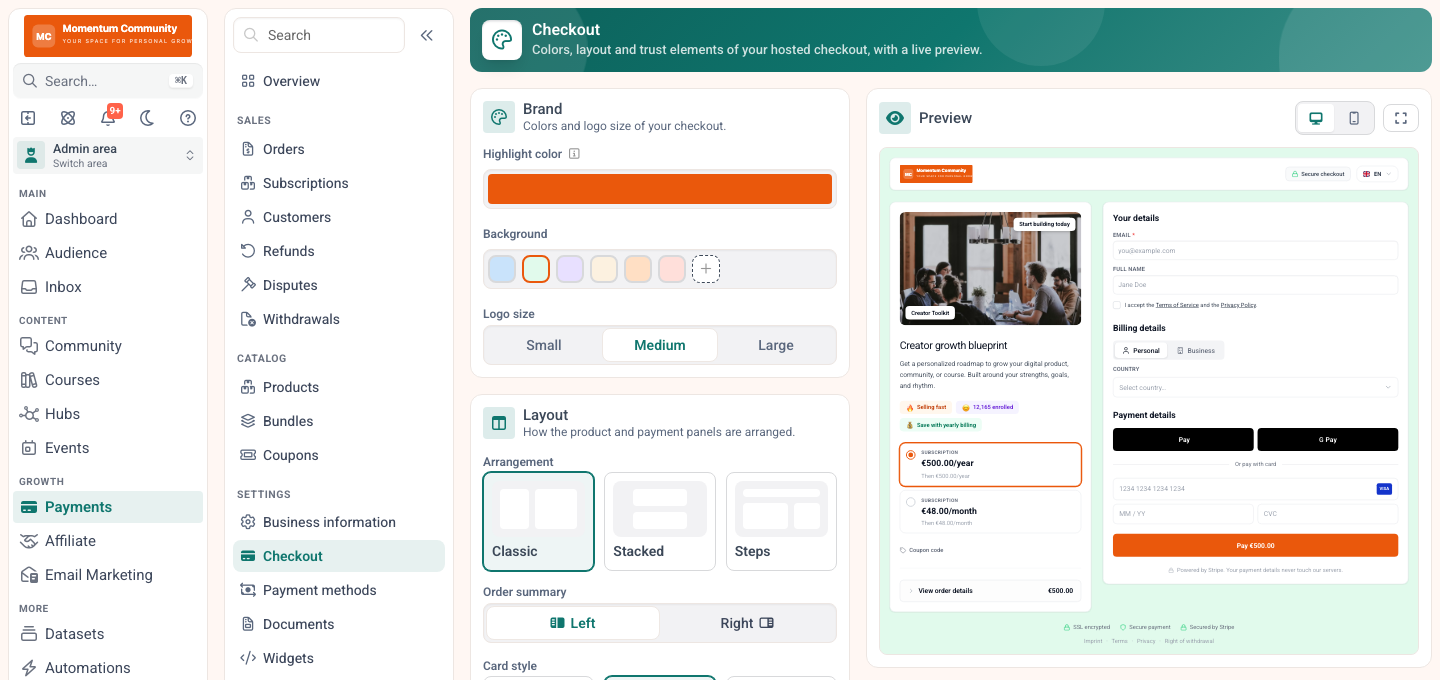
The checkout is configured in the designer, and the preview shows every change immediately.
2. The email list as your most important channel
If you can build only a single channel, build this one. Your email list belongs to you, unlike followers on someone else's platform, and it reaches people directly in their inbox. In almost every course business the bulk of sales comes from email, not from social media.
Collect email addresses with a useful free offer, such as a checklist, a mini course or a webinar. Maintain the list with regular, valuable emails so you are not writing only when you want to sell something. At launch, a well maintained list is then your most reliable lever for selling an online course.
A simple starting point is an automatic welcome sequence: three to five emails that greet new contacts, deliver your best free knowledge and gently lead to the course at the end. That way your list sells even when you are not actively launching, and every new contact goes through the same well considered path. How to fill that list at all is in email marketing for online courses.
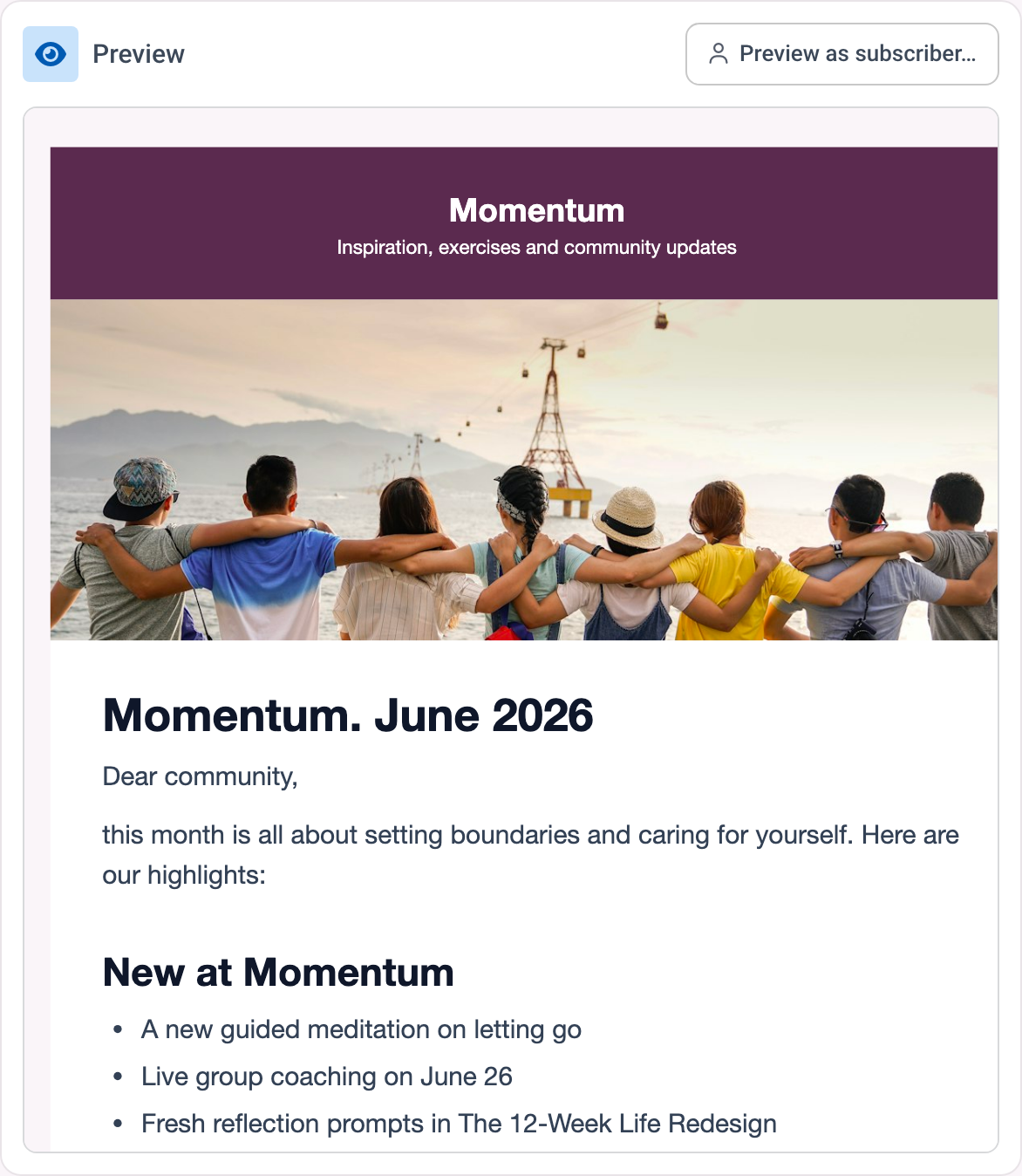
Newsletters and launch emails are built in the same tool as the course, and the preview shows the finished email.
3. Webinars and live events for selling courses
A webinar is one of the strongest sales formats there is, because it bundles knowledge, trust and offer into one session. You deliver real value first, answer questions live and present your course at the end as the logical next step.
The structure is usually the same: a clearly defined topic that addresses a concrete problem, a practical main part and a time-limited offer at the close. The scarcity, such as a bonus only for attendees or a discount for a few days, provides the decisive push. A recording of the webinar also keeps selling afterwards.
You can run webinars live or offer them as an automated recording. Live feels more personal and allows real questions, while an automated webinar runs around the clock and sells while you work on something else. Many start live to sharpen the format and only automate the version that demonstrably sells. How to turn it into a permanent channel is shown in the webinar as a lead magnet.
4. Using affiliate partners
Why sell alone when others can promote for you? In an affiliate programme, partners recommend your course and receive a commission for every sale they bring. You only pay for actual sales, so the risk is low, and you reach audiences you would not otherwise get to.
Good affiliates are people who already reach your audience: other providers with a complementary topic, bloggers or satisfied customers. Give them clear materials and an attractive commission rate. What an integrated partner programme looks like is on the affiliate page.
On commission the rule is: better generous than stingy. An affiliate receiving thirty or forty percent promotes your course with real commitment, and you earn from customers you would never have reached. What matters is clean, traceable accounting so partners trust you and stay long term. The complete build of a partner programme is described in affiliate marketing for your membership site.
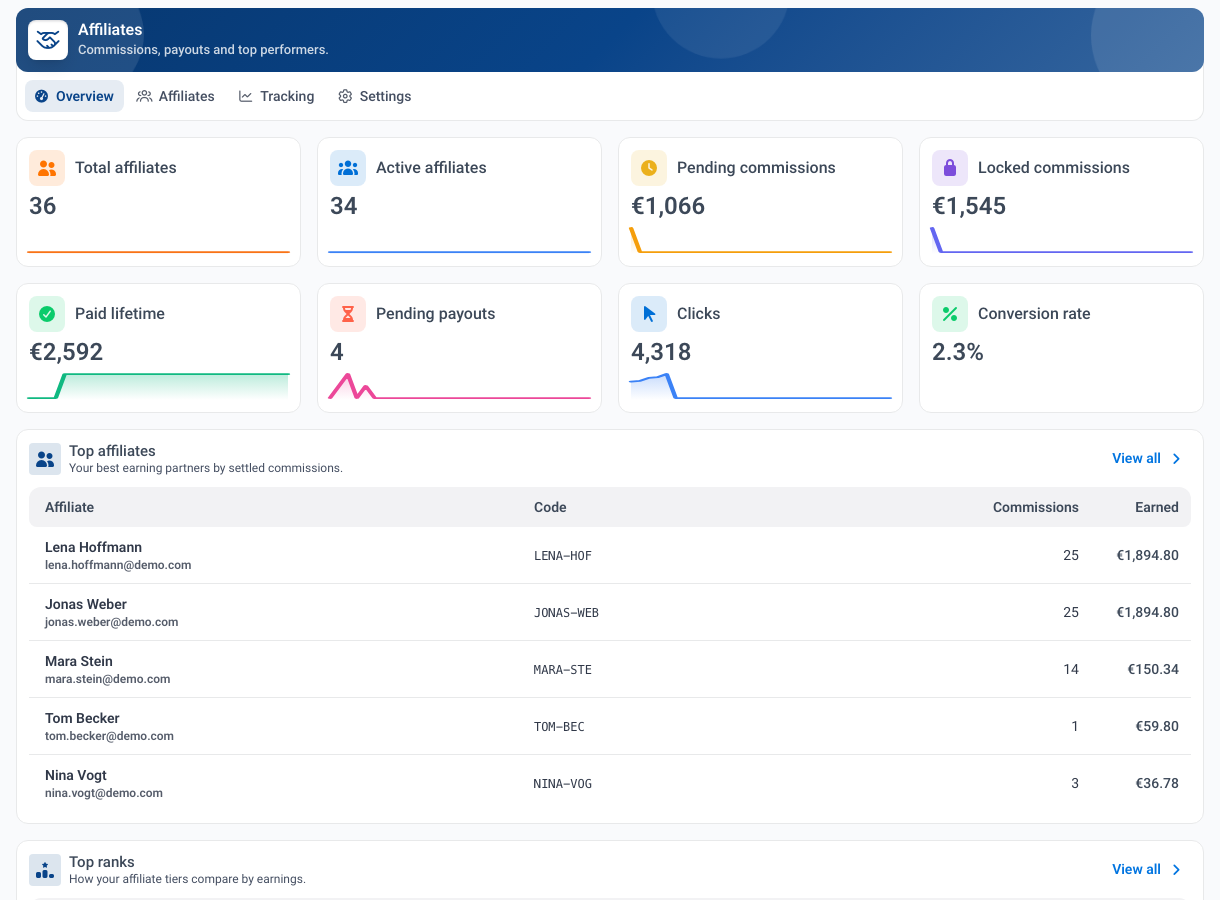
Every commission is tied to a partner and a sale, which makes the accounting traceable.
5. SEO as a long-term channel
Search engines bring visitors who are actively looking for a solution, so at exactly the right moment. SEO is not a fast channel but a lasting one: an article that ranks for the right terms brings new prospects month after month without you paying continuously.
Write content on the questions your audience asks before buying and link to your course within it. Over time a steady stream of visitors builds that complements your other channels. In combination with an email list in particular, SEO is a strong engine for selling an online course long term. Where to start when the site has no rankings yet is in SEO for coaches.
6. Paid advertising: when is it worth it?
Paid ads can accelerate sales but are no substitute for the basics. Advertising only pays off once your offer sells without it, meaning you know your sales page and your price work. Otherwise you burn budget to paper over an unsolved problem.
Start with a small budget, ideally promote your webinar or your free offer rather than the course directly, and measure precisely what a won customer costs. As long as you get back more than a euro for every euro invested, you can scale. Paid advertising is an amplifier, not a foundation.
Keep the longer perspective in view too. A customer who buys today may recommend you or buy a second offer later. So a won customer may cost a little more at first, as long as the total value over time works out and you actually offer those follow-up purchases.
7. Planning the launch properly
A planned launch almost always beats a quiet release. Instead of simply putting the course online, you build anticipation over days: free content in advance, a signup phase with a clear start and end date, and targeted emails to everyone who showed interest.
A proven approach is open enrolment for a limited window with an early-bird or bonus incentive. The time limit provides the push to decide. After the launch you convert it into an always-available offer that keeps selling through SEO and email.
Plan the time after the launch as well. A successful start is nice, but sustainable revenue comes afterwards, when you make the offer permanently available through your content and your list. That turns a one-off event into a reliable channel for selling an online course week after week.
8. Sell your course on memberarea.io
Whichever channel you sell through, in the end you need a frictionless checkout. On memberarea.io selling is built in: a branded checkout, coupons, order bumps and upsells, one-off payment, instalments or subscription, plus an integrated affiliate programme. Payments run natively through Stripe with no additional platform transaction fee, so more of every sale stays with you.
That way you build course, sales page, checkout and partner programme in one platform instead of connecting several tools. More on checkout is on the checkout page, an overview of all payment features on the payments page, and the plans on the pricing page.
Sell your course on memberarea.io, checkout included. Try memberarea.io free and set up course, checkout and affiliate programme in a single platform.
Which channel suits you?
You do not have to walk all the routes at once. If you already have reach, start with social media and email. If you like speaking, go for webinars. If you prefer writing, build on SEO. And if you have little time, let others sell through affiliates. What matters is genuinely mastering one channel before adding the next, because two well maintained channels beat five half-hearted ones.
A good rhythm is to commit around ninety days to one channel, honestly measure whether it brings sales, and only then decide whether to expand it or test another. That way you do not spread yourself thin and you decide on the basis of numbers rather than restlessness.
Frequently asked questions
How do I sell my first online course? Fastest through the people who already know you. A small email list or an existing customer relationship brings the first sales more reliably than any ad. Paid advertising only pays off once the course demonstrably sells.
How many prospects do I need for the first sale? As rough orientation, one to three percent of a warm email list buys. At 200 contacts that is two to six sales, which is entirely enough for a first run.
Should I sell my course through a marketplace? Marketplaces bring reach but keep the customer relationship and push the price down through discount campaigns. They can create visibility early on, but as your only channel they give you little control.
How often may I write during a launch week? More often than feels right. Three to five emails in five days is normal, and the last day regularly brings the largest share of sales.
What if nobody buys? Check in this order: does the audience even recognise the problem, is the promised outcome concrete enough, and does the price match the benefit. In most cases it is not the price but a promise that is too vague.
Conclusion
Selling an online course is not a gamble but the result of a few well chosen channels. Build audience and email list first, use social media and webinars to create trust, and add affiliates, SEO and paid advertising once the basics are in place. Plan your launch deliberately rather than just hoping.
Start with one or two channels that suit you and get genuinely good at them before adding the next. Start free on memberarea.io and make the step from a finished course to a first seat sold.



Ready to build your membership?
Try it free for 14 days. No credit card, no setup fees. Launch in minutes.
No credit card required · Cancel anytime