
Blog
Club Membership Management: The Best Solution for 2026
Digitising membership management for your club: dues, communication and content on one platform instead of scattered spreadsheets.
By industryMany clubs and associations still manage their members in spreadsheets, folders and email lists. That works while the club is small but gets more laborious with every new member. Digital membership management takes a lot of work off the committee and volunteers and makes sure nothing slips through the net.
This guide shows why spreadsheet-based administration hits its limits, what a good digital solution should deliver, and how to bundle dues, communication and content for your members in one place. The goal is a club that spends less time on administration and more on what it is actually about.
The short answer: a central member register as the single source, dues collected automatically by direct debit, communication by group rather than mailing list, documents behind a login. Start with dues collection; that is where volunteers do the most manual work.
Why spreadsheet-based membership management is no longer enough
A spreadsheet is quickly created but grows over the club's head. Data ages, several versions circulate, and nobody knows exactly which is current. As soon as several committee members work on it, shared upkeep becomes a source of errors, and important information sits scattered across different computers.
Then there is the manual effort with dues. Who has paid, who is in arrears, who has resigned? In a spreadsheet all that has to be maintained by hand, which costs time and is error-prone. In volunteer work in particular, where time is especially scarce, this administration eats hours better spent on the club's work.
What the manual work costs per year
A club with 200 members and a €60 annual fee takes in €12,000 a year. If the treasurer checks every transfer by hand and you count two minutes per item, that is around seven hours just for reconciliation, plus chasing those in arrears. The figures are assumptions, but every treasurer recognises the order of magnitude. Automatic collection turns those seven hours into a glance at an overview.
Data protection is a topic too. Member data is personal data and does not belong unsecured in a spreadsheet emailed around. A central, access-protected solution is not only more convenient here but also the more responsible way to handle your members' data.
Article 32 of the GDPR requires appropriate technical and organisational measures for a level of security appropriate to the risk, expressly naming encryption, the ongoing confidentiality and availability of systems, and a process for regularly testing those measures (Art. 32 GDPR). A member list as a spreadsheet attachment in a mailing list fulfils little of that. This is no formality: it concerns your own members' addresses and bank details.
Another problem is the handover when the committee changes. In clubs, roles change regularly, and with them the knowledge of where which data sits and how something works. A central platform makes that handover considerably easier, because everything is documented in one place and the new committee does not first have to hunt down spreadsheets and folders. That keeps the club able to act even when the people at the top change.
What digital membership management should deliver
Good membership management bundles the key tasks in one place. That includes a central member register where all data is current and accessible to authorised people. Instead of several spreadsheet versions there is a single, reliable source.
Add the collection of dues, orderly communication with members and a place for documents and content. Ideally groups or sections can be mapped too, such as different divisions in a sports club. The more of that a single solution covers, the fewer tools the committee has to juggle.
Exactly that bundling is the decisive difference from isolated solutions. When member data, dues and communication sit in separate programmes, duplicate upkeep arises along with the risk of information drifting apart. An integrated platform keeps everything in sync: when a member changes their details, it is current everywhere, from dues collection to the mailing list. That saves time and prevents embarrassing errors.
Usable by people doing this on the side
Simplicity matters as well. Clubs often involve people who are not technical experts and give their time voluntarily. A complicated solution will not be used. A clear, simple interface ensures that changing committees and helpers find their way quickly.
A good yardstick is whether a new committee member finds their way without training. When the key tasks are intuitively reachable, the barrier to using the system at all drops. So when choosing, look not only at feature scope but at how the solution feels day to day, because volunteers with scarce time will be the ones working with it.
Collecting dues: SEPA and direct debit
Membership dues are the financial basis of many clubs, and collecting them is often the biggest administrative burden. Checking manual transfers one by one is laborious and error-prone. Far more efficient is automated collection, ideally by direct debit, so dues arrive regularly without constant chasing.
A modern solution maps recurring dues as a subscription and collects them automatically. memberarea.io processes payments natively through Stripe, which also supports SEPA direct debit, so membership dues can be collected regularly and automatically. That reduces payment failures and saves the treasurer a lot of manual work. More is in the payments area.
The deadline every treasurer should know
With an authorised SEPA direct debit the member can demand a refund but has to assert the claim within eight weeks of the debit (§ 675x BGB, German civil code). In practice that means: do not debit dues as a single annual sum without notice, but announce the collection and keep the mandate cleanly documented. Returned debits cost fees and nerves, and you avoid both with an announcement that surprises nobody.
Automatic reminders on failed payments and a clear overview of outstanding dues round out the picture. That way the committee sees the state of dues at any time without combing through a spreadsheet. Check the payment routes suitable for your club in detail, because the specific requirements differ from club to club.
| Fee model | Typical payment | What to watch |
|---|---|---|
| Full member | annually or monthly | one model as the standard, everything else derives from it |
| Reduced (students, pupils) | like full members | proof and an end date, or the reduction lasts forever |
| Family membership | annually | who pays, who is included, how many people |
| Supporting member | freely chosen | delimit rights clearly, such as no voting right |
| Joining fee | once on entry | book separately from the ongoing fee |
One model per row, every member assigned to exactly one model. How direct debit collection works technically is described in setting up SEPA payments.
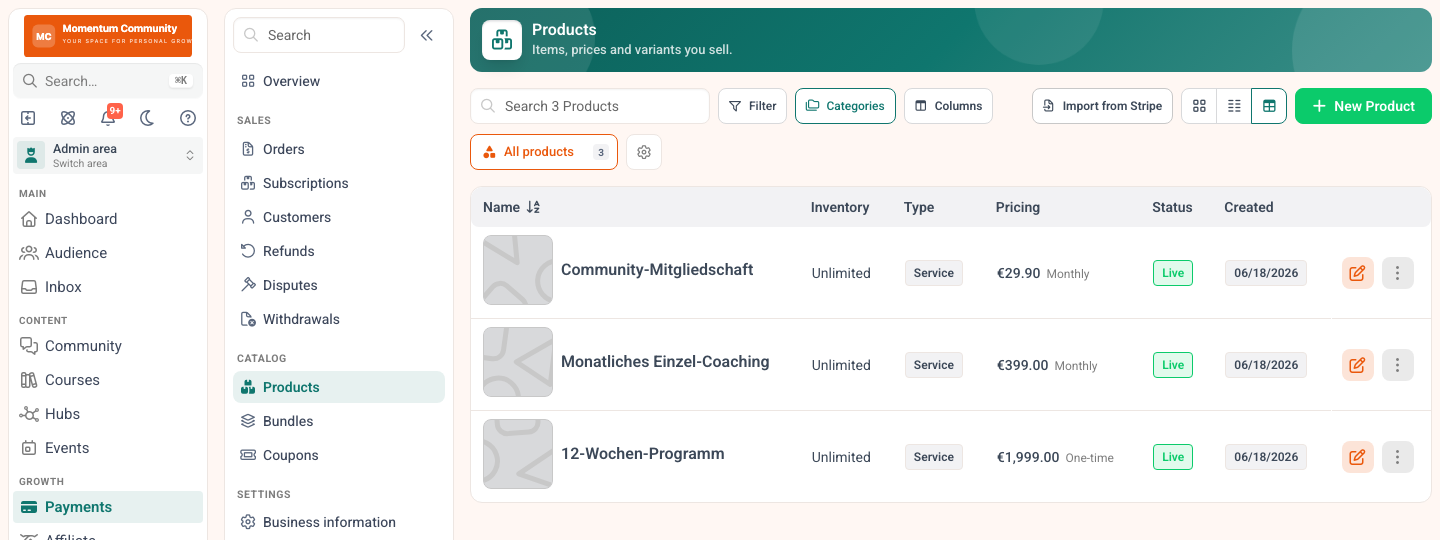
Fee models are products with recurring payment, nothing exotic.
Different fee models can be mapped cleanly digitally too. Reduced fees for students, families or supporting members, annual or monthly payment and one-off joining fees are no problem when the platform supports flexible pricing models. Instead of managing all that by hand, you assign members to the right model and collection runs automatically at the right rhythm.
Communication and community in the club
A club lives on cohesion, and that comes from communication. A digital platform lets you inform members deliberately without maintaining unwieldy email lists. Announcements, dates and news reach the right people reliably.
Even more valuable is a community area where members can exchange ideas. Instead of everything running through the committee, a place arises where members ask questions, organise themselves and shape club life. Through the community you can create exactly that digital meeting point that holds the club together beyond in-person events.
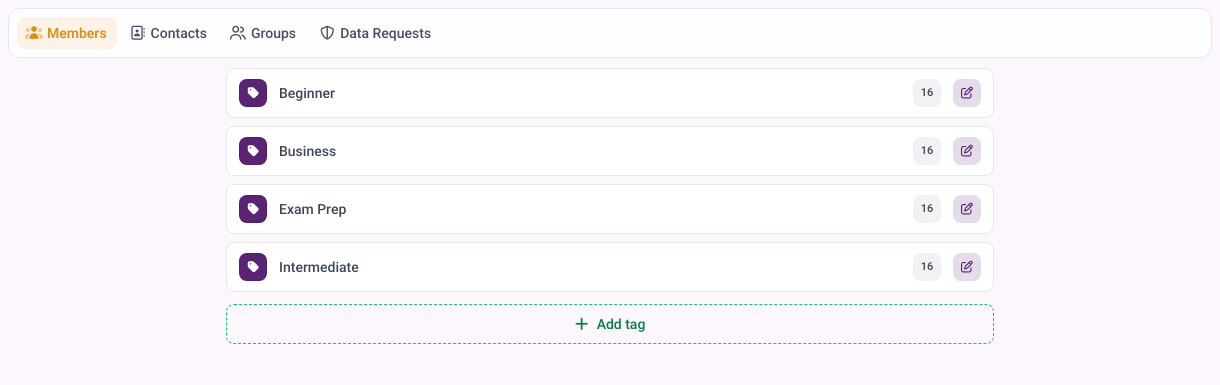
Divisions can be mapped as tags. Whoever carries the right tag automatically gets the right information.
For clubs with distributed members or several divisions in particular that is a big gain. Groups for individual divisions, projects or events keep communication clear and ensure everyone gets exactly the information relevant to them.
Lively online communication can also raise participation in club life. Someone who stays in contact between meetings feels more involved and is more likely to get engaged. Younger members in particular expect a digital line to the club today, and a simple, well moderated space for exchange can meet exactly that expectation and win new active members. How such a space comes about is described in building an online community, the ongoing upkeep in community management.
Documents and content for club members
Clubs accumulate many documents over time: statutes, minutes, forms, training plans or course materials. Storing those scattered means nobody finds what they are looking for. A central platform gives all that content a fixed place where members can access it any time.
Beyond that you can provide content deliberately, such as training for new members, guides or exclusive materials for particular groups. Pure administration becomes real added value for members, which strengthens their attachment to the club. With structured course content you can even map the induction of new members or the training of instructors. How such a welcome is structured is shown in member onboarding.
Internal documents belong behind a login
Protecting sensitive documents also gets easier. Instead of distributing minutes and internal papers by email, they sit protected in one place only authorised members can access. That is not only tidier but also the safer route, especially when documents contain personal data or confidential decisions.
The advantage of an integrated solution here too is the overview. Instead of maintaining documents, member data and dues in separate systems, you have everything in one place and save the laborious hunting that otherwise eats so much time in club life.
memberarea.io for clubs
memberarea.io combines membership management, dues, communication and content in one platform and therefore fits club requirements well. Members, groups and content sit in one place, dues run automatically through Stripe including SEPA direct debit, and through the community the club stays connected.
For clubs with a European membership, the GDPR-compliant orientation with EU hosting is an important argument, especially because member data has to be protected carefully. With automations, onboarding of new members and reminders can be steered without additional software; the patterns for that are collected in onboarding automation. Current terms are on the pricing page.
The biggest gain is relief for the volunteers. Less manual work with dues, clear communication and a single reliable data source mean more time for the club's actual work. That digitises your club without overwhelming the committee with complicated technology.
A switch in four steps
| Step | What you do | Realistic timeframe |
|---|---|---|
| 1. Register | import a cleaned member list, remove duplicates | one evening |
| 2. Dues | create fee models, collect mandates, start collection | two to four weeks, because members have to play along |
| 3. Communication | groups per division, send the first announcement through them | one afternoon |
| 4. Documents | put statutes, minutes and forms behind the login | one evening |
Only step 2 really takes time, because it depends on members participating. Everything else is done in a weekend.
A practical tip for getting started: begin with the biggest pain point. For most clubs that is dues collection or the outdated member register. Once that first area runs cleanly, the committee feels the benefit immediately and the remaining steps come easier. A gradual rollout prevents the switch from overwhelming volunteers and ensures everyone supports the benefit from the start.
Frequently asked questions
Is digital membership management worth it for small clubs too? Yes, for small clubs in particular, because it spares scarce volunteer time. Automated dues collection alone saves noticeable effort and reduces payment failures.
Can several committee members work together? Yes. A central platform replaces scattered spreadsheets with a shared, current data source authorised people can access. That ends the version chaos.
What about the data protection of member data? Member data is sensitive. Look for a GDPR-compliant, EU-hosted solution with clear access rights and clarify legal details with a qualified person in doubt.
How laborious is switching from spreadsheets to a platform? Manageable if you go step by step. Start with the biggest pain point, such as dues collection, and transfer the member data once. After that the ongoing effort drops considerably.
Conclusion
Digital membership management frees your club from spreadsheet chaos and manual dues collection. It bundles member data, dues, communication and content in one place and gives volunteers their time back. Look for simplicity, automated dues and data protection, and introduce the solution step by step. Start free with memberarea.io and digitise your club on one platform.



Ready to build your membership?
Try it free for 14 days. No credit card, no setup fees. Launch in minutes.
No credit card required · Cancel anytime