
Blog
How to Build a Fitness Membership Site: Step-by-Step Guide
Build a fitness membership site that earns recurring revenue: video workouts, programs, a community for accountability, pricing and your first 50 members.
By industryA fitness membership site turns the work you already do as a trainer or coach into recurring income that does not depend on filling a class or booking back to back sessions. Instead of trading every hour for a single payment, you package your workouts, programs and expertise into a membership that people pay for month after month. Done well, it gives you a more stable income, more time, and the ability to help far more clients than your calendar ever could.
This step by step guide walks through how personal trainers and fitness coaches build a fitness membership site that members actually stick with. You will see which content formats work, how to use community to drive accountability and retention, how to price your membership, what to look for in a platform, and how to land your first fifty members. The goal is a membership your clients value enough to keep paying for, not a library of videos they forget about after week one.
The short answer: pick one clear goal, deliver it as a structured program plus an on demand library, add one live touchpoint a week and a community where members check in. Fifty members at €49 a month is €2,450 in recurring revenue, and retention, not traffic, is what decides whether that number holds.
Why a fitness membership site works
The reason a fitness membership site works so well is that fitness is never finished. Nobody does one workout and is done forever, which makes it a natural fit for an ongoing subscription rather than a one off sale. Members keep coming back because their goals keep evolving, and that recurring need is exactly what a membership is built to serve.
What fifty members actually earn
The arithmetic is worth doing before anything else, because it sets how much content and coaching you can afford to put in:
| Monthly price | 50 members | 100 members | Per year at 50 members |
|---|---|---|---|
| €29 | €1,450 | €2,900 | €17,400 |
| €49 | €2,450 | €4,900 | €29,400 |
| €79 | €3,950 | €7,900 | €47,400 |
Plain multiplication, not a forecast. Gross figures before tax and before payment processing, which adds roughly 2.9 percent (see Stripe pricing). Churn is what makes the real number lower, which is why the community section below matters as much as the content section.
Selling access instead of hours
For you, the business case is recurring revenue. A handful of paying members compounds into predictable monthly income that does not reset to zero at the start of each month. Fifty members on a modest monthly fee can rival or beat a packed in person schedule, without the ceiling that comes from only having so many hours in a day. That predictability also lets you plan, invest in better content, and stop chasing the next one off booking.
There is a delivery advantage too. A membership lets you serve clients who could never train with you in person because of distance, schedule or budget. Your reach stops being limited by your local area and your calendar, and a single well made program can help hundreds of people at once. For many trainers, that shift from selling time to selling access is what finally makes the business scalable.
The catch is that a membership only works if people stay. Recurring revenue is wonderful when members renew and painful when they churn after a month. That is why the rest of this guide focuses as much on retention, through content variety and community, as it does on getting people through the door in the first place.
Content formats: video workouts, programs, live sessions
Start with the library, then build the path
The core of any fitness membership site is the content, and the strongest memberships mix several formats rather than relying on one. The foundation is usually a library of on demand video workouts that members can follow whenever it suits them. Variety here matters: different lengths, intensities and focuses keep things fresh and let members pick what fits their day, which is a big part of why they keep logging in.
On top of the library sit structured programs. A loose pile of videos is easy to ignore, but a guided six or eight week program gives members a clear path and a sense of progress. Releasing the next phase on a schedule, often called drip content, stops people from skipping ahead and keeps them engaged week after week. Structured programs are also what turn a casual browser into someone who feels they are getting real results.
One live hour a week does the heavy lifting
Live sessions add the human element that recorded content cannot. A weekly live workout, a form check or a question and answer session creates a reason to show up at a set time and reminds members there is a real coach behind the screen. Even one regular live touchpoint a week noticeably lifts engagement and makes the membership feel personal rather than automated.
| Format | Your effort | What members get from it |
|---|---|---|
| On demand library | filmed once, reused for years | a workout that fits today, whatever today looks like |
| Structured program | planned once, released on a schedule | a path with a beginning and an end, so progress is visible |
| Weekly live session | one fixed hour every week | a real coach, a fixed appointment, form corrections |
| Extras: nutrition, mobility, habits | added gradually | support for the whole goal, not just the workout hour |
The mix matters more than any single format. A library alone is easy to cancel, a program alone runs out.
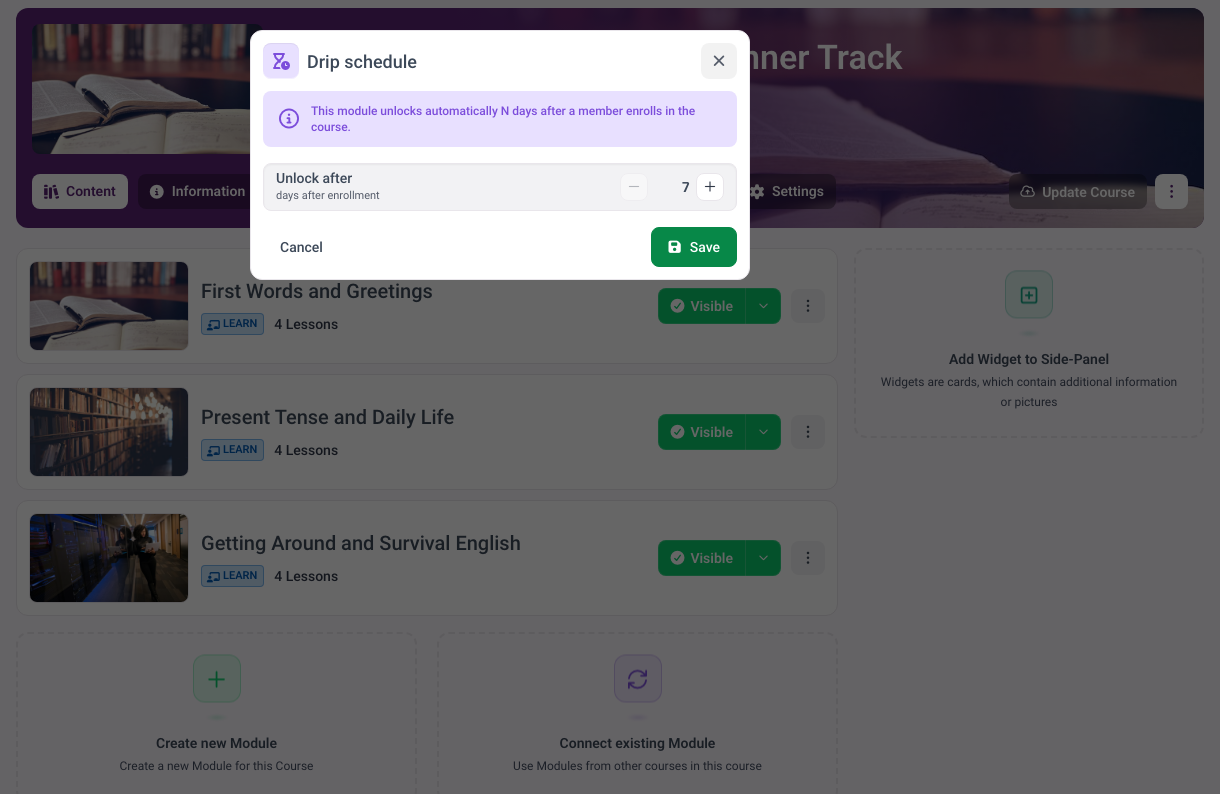
Scheduled release keeps an eight week program on eight weeks instead of one weekend binge. The mechanics are covered in drip course content.
When you plan the weekly load, the World Health Organization gives you a defensible anchor: adults should get 150 to 300 minutes of moderate intensity aerobic activity a week, plus muscle strengthening on two or more days (WHO physical activity fact sheet). Three 40 minute sessions plus a mobility day lands inside that range, and saying so in your sales page turns a vague promise into a specific one.
Around the core you can layer extras that increase the value: nutrition guidance, downloadable plans, mobility routines or habit challenges. The aim is a membership that supports the whole goal, not just the workout hour, so members feel the price is more than fair. The richer and more connected the content, the longer people stay.
Building a community for accountability
Content gets members in the door, but community is what keeps them. In fitness especially, accountability is the difference between someone who quietly cancels after three weeks and someone who stays for a year. A space where members check in, share progress and cheer each other on turns a solo grind into something people do not want to drop out of.
A built in community gives your members a place to post their workouts, ask questions and celebrate milestones. That sense of belonging is powerful: people are far more likely to stick with a program when they feel part of a group that notices whether they show up. The community feature lets you create exactly that space, tied directly to your content rather than scattered across a free social network you do not control.
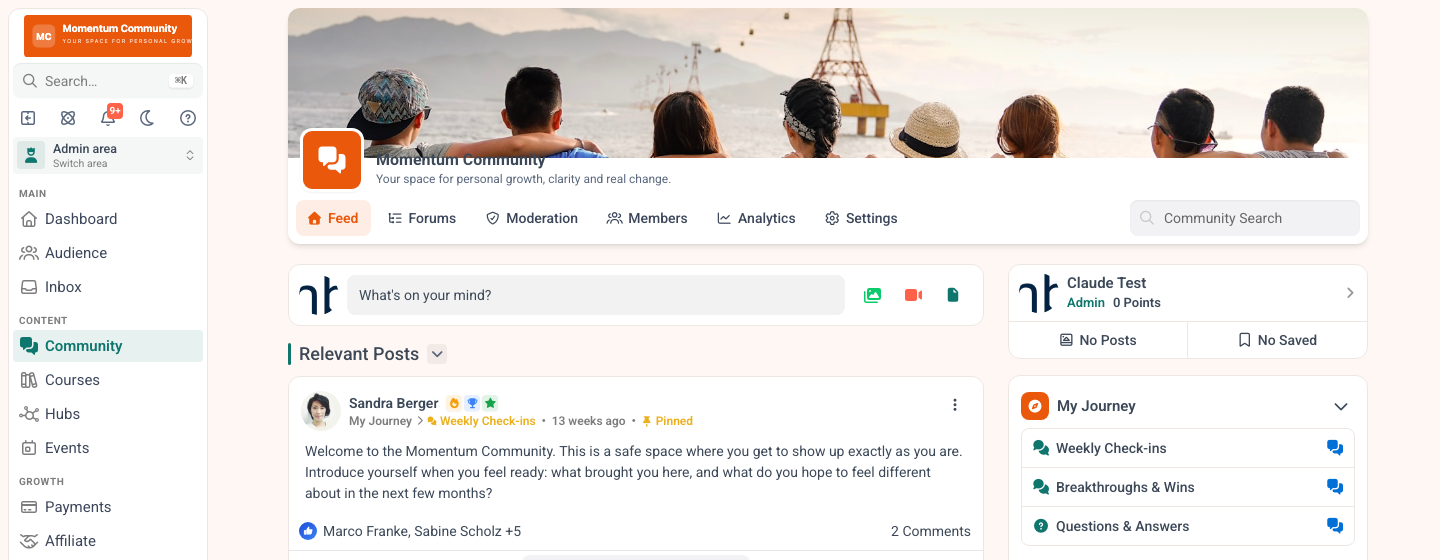
A check in thread is the cheapest retention tool you have.
Structure beats good intentions
Accountability can be structured. Monthly challenges, progress threads, leaderboards or small accountability groups give members concrete reasons to engage between workouts. As the coach, your presence matters most at the start: when you reply, encourage and set the tone, the community comes alive and eventually starts to sustain itself as members support one another.
The retention payoff is direct. Every extra month a member stays is pure recurring revenue you did not have to win again, and an engaged community is one of the most reliable ways to extend how long people stay. It also becomes your best marketing, because members who feel part of something talk about it and bring friends along. The patterns that keep people from drifting away are collected in reduce community churn.
Pricing your fitness membership
Pricing a fitness membership site is about matching the price to the ongoing value you deliver, not undercutting the gym down the road. Because members pay every month, even a modest fee adds up to meaningful recurring revenue, and a price that is too low can actually signal that the membership is not serious. Aim for a number that reflects the real coaching, structure and community you provide. The full method, including how to test a price without punishing early members, is in how to price an online course.
A single straightforward monthly price is the easiest place to start, and you can refine from there. Many trainers add an annual option at a discount to improve cash flow and lock in commitment, and some offer tiers, for example a self guided plan and a premium tier with live sessions or personal feedback. Keep the choices simple so members are not paralysed by options.
Your platform should make all of this effortless to run. Payments need to recur reliably, handle failed charges gracefully and let you offer monthly and annual options without manual work. MemberArea processes payments natively through Stripe, so recurring memberships, annual plans and tiered pricing all work out of the box, and you can see how that side works on the payments page. There are no per member fees, so your pricing stays predictable as you grow.
Do not be afraid to test and adjust over time. Many trainers start too cheap out of nervousness, then find that a fair price attracts more committed members who actually use the membership and stay longer. Begin with a price you can defend by the value inside, watch how members respond, and refine it with each cohort.
Platform requirements for fitness content
Fitness content has specific demands, so the platform you build on matters. The first requirement is smooth, reliable video. Your workouts are the product, and members will not tolerate clunky playback, so you want hosting that streams cleanly on phones, tablets and laptops, since people train wherever they are. Mobile experience is not optional in fitness, it is the main way members use your content.
Programs, not a pile of videos
The second requirement is the ability to structure programs and drip content. You need to group workouts into programs, control the order, and release phases on a schedule so members follow the path you designed. A platform that handles structured courses with scheduled release gives you exactly that control without any technical work on your part.
Third, the platform should bring community, payments and content together rather than forcing you to stitch separate tools around a video host. Running workouts in one app, a community in another and billing in a third is fragile and time consuming. An all in one platform keeps members, content, community and revenue under a single login, which is far easier to manage as a busy coach. Membership site software compares what the main options include. For trainers in Europe, GDPR ready hosting in the EU is worth confirming, since member data is personal.
Finally, look for automation. Onboarding new members, sending reminders and following up should run on their own so you can spend your time coaching rather than on admin. The less the software asks of you each week, the more sustainable your membership becomes.
Getting your first 50 fitness members
The first members are the hardest, and the goal at this stage is momentum, not perfection. Start with the audience you already have: existing clients, social media followers and your email list. The people who already know and trust you are the most likely to join early, so make them a direct, personal offer rather than waiting for strangers to find you.
Make the first cohort an offer they cannot get later
An early bird or founding member offer works well to get the first cohort in. A reduced price or a bonus for the first members rewards them for taking a chance before you have a wall of testimonials, and it creates urgency. Those founding members are gold, because their results and feedback become the proof that convinces the next wave to join.
Give people a low risk way to try the membership. A free trial, a low priced first month or a free challenge that leads into the paid membership lets potential members feel the value before committing. A week long challenge inside your community, for instance, both demonstrates what you offer and warms people up to subscribe when it ends.
From there, let your members do the marketing. Encourage them to share their progress, ask happy members for testimonials, and consider a referral incentive so word of mouth compounds. Keep showing up, keep delivering results, and the first fifty members become the foundation that makes the next hundred far easier to reach. The channels that work after your own audience is exhausted are covered in getting your first 100 members.
Frequently asked questions
Do I need a huge following to start a fitness membership site? No. Most successful memberships start small, often from an existing client base or a modest social following. Fifty committed members on a recurring plan is already a real business, and you grow from there through results and referrals.
How much content do I need before launching? Less than you think. A solid starter library plus one structured program and a regular live session is enough to launch. Adding fresh content over time is actually a strength, because it gives members a reason to stay subscribed.
How do I stop members from cancelling? Retention comes from variety and community. Mix on demand workouts, structured programs and live sessions so the membership stays fresh, and build an active community for accountability. Engaged members who feel part of a group stay far longer than those working out alone.
What should I charge? Price to the ongoing value, not the cheapest gym nearby. A fair monthly fee with an optional discounted annual plan works well for most trainers. Start with a price you can defend by what is inside, then adjust as you learn how members respond.
A fitness membership site lets you turn your expertise into recurring revenue while helping more people than your schedule ever allowed. Build varied content, lead an accountable community, price for the value you deliver and land your first members from the audience you already have. Launch your fitness membership on MemberArea and start building recurring income today.



Ready to build your membership?
Try it free for 14 days. No credit card, no setup fees. Launch in minutes.
No credit card required · Cancel anytime