
Blog
How to Sell Language Courses Online: Platform and Pricing
Learn how to sell language courses online: structure an async curriculum, use community for speaking practice, price your courses and reach learners.
By industryIf you teach a language, the demand for what you do has never been higher, and the internet means your students no longer have to live in your city. Learning to sell language courses online lets you turn lessons you would otherwise give one at a time into structured courses that reach learners anywhere, around the clock. Done well, it builds an income that is not capped by the hours in your week and a school that grows while you sleep.
This guide is a complete walkthrough for language teachers and schools who want to sell language courses online and build a real learning community around them. You will see what makes language courses different from other online courses, how to structure a curriculum for self paced learning, how to use community for the speaking practice that languages demand, how to price your offer, and how to market to language learners. The goal is an online language school that teaches well and sells consistently.
The short answer: structure the course by level so learners know where they stand, build production into every lesson rather than adding practice at the end, and price it as an ongoing subscription because learning a language is ongoing. Community is not a bonus here, it is where the speaking happens.
What it takes to sell language courses online
Before you build anything, it helps to understand why selling language courses online is not quite like selling any other course. Languages are a skill, not just knowledge, and a skill has to be practised, not only watched. That single fact shapes everything about how you design, deliver and sell your courses, because a pile of grammar videos alone will not get anyone speaking.
The first implication is that interaction matters more than in most subjects. A learner can absorb a marketing course largely by watching, but a language learner has to produce the language, speak it, write it and use it, to actually progress. The courses that succeed build in practice and feedback rather than relying on passive video, and that is a big part of what makes them worth paying for.
The second implication is motivation. Languages take time, and many learners start enthusiastically and then drift away when progress feels slow. To sell language courses online successfully, you are not just selling content, you are selling a path that keeps people going: clear milestones, a sense of progress, and a community that makes them feel they are not learning alone. Retention is part of the product.
The third implication is trust. Learners are choosing a teacher as much as a course, so your credibility, your teaching style and the results your students get are central to the sale. The good news is that this works in your favour: a teacher who shows genuine expertise and a method that works can stand out easily, even in a crowded market.
Structuring a language curriculum for async learning
Selling courses online means most learning happens asynchronously, without you live in the room, so your curriculum has to carry the structure a classroom normally provides. The strongest approach is to build a clear, level based path, for example beginner, intermediate and advanced, so every learner knows exactly where to start and what comes next. A defined journey is far easier to sell and to finish than a loose collection of lessons.
Use the levels learners already know
You do not have to invent a level system. The Common European Framework of Reference describes language ability on a six-point scale from A1 for beginners up to C2 for those who have mastered a language (Cambridge English on the CEFR), and learners across Europe already recognise those labels.
| Level | What you sell at this level | What the learner wants |
|---|---|---|
| A1 to A2 | the entry course, the widest audience | survival phrases and a first conversation |
| B1 to B2 | the core of your school, where people stay longest | to hold a real conversation without freezing |
| C1 to C2 | a small, high value group | nuance, register, professional precision |
How many hours each level takes varies by language and by learner, so avoid promising a number you cannot stand behind. Naming the level is enough, and it does the selling by itself.
Within each level, break the material into small, focused lessons that each teach one thing well, whether that is a grammar point, a set of vocabulary or a practical situation like ordering food or a job interview. Short, themed lessons fit into busy lives and give learners frequent wins, which keeps them moving. Releasing lessons on a schedule, often called drip content, can also keep pace steady and stop people from burning out by bingeing and then quitting.
Crucially, build practice into the structure rather than bolting it on. Each lesson should include a way to use the language: exercises, speaking prompts, writing tasks or short quizzes that check understanding. Asynchronous does not have to mean passive, and the courses that work weave doing into every step so learners are producing the language from the start, not just consuming explanations.
A platform that handles structured courses with ordered lessons and scheduled release lets you deliver this path without technical hassle. You build the curriculum once, set the order and pacing, and every new learner walks the same proven route. That reusability is exactly what makes it possible to teach far more students than you ever could live. The build itself is covered in how to create an online course, and scheduled release in drip course content.
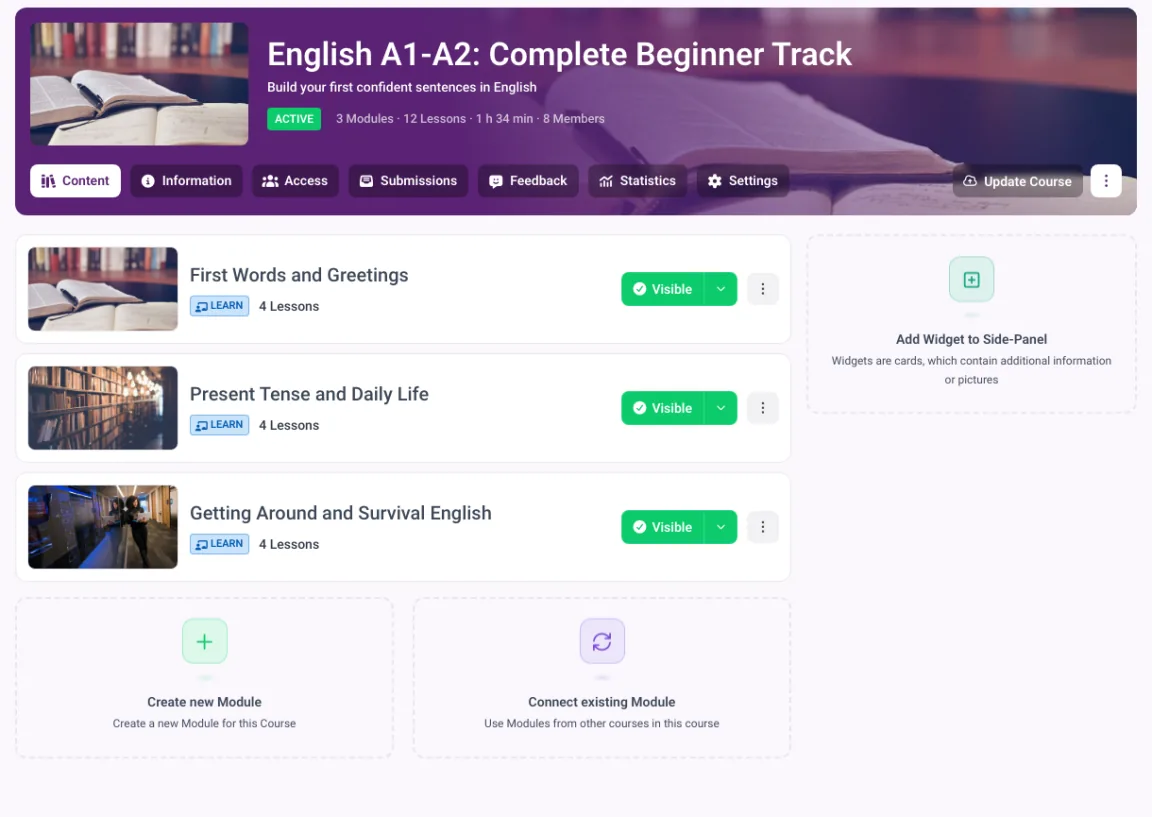
One module per topic, one lesson per idea. The level lives in the course, the topic in the module.
Audio courses carry a captioning duty
Language courses lean on audio more than most, which brings an accessibility obligation with it. The Web Content Accessibility Guidelines require captions for all prerecorded audio content in synchronised media at Level A, the lowest conformance level (WCAG 2.2, Success Criterion 1.2.2). For a language school this is less of a burden than it sounds: a transcript of every dialogue is something learners want anyway, and it doubles as searchable text and reading practice.
Using community for speaking practice
The hardest thing to deliver in a self paced language course is speaking practice, and it is also the thing learners want most. This is where community becomes not a bonus but a core part of the product. A space where learners can practise with each other and with you turns a lonely solo course into a living language school, and that is often the difference between students who finish and students who quietly disappear.
A built in community gives your learners somewhere to use the language for real: writing posts in the target language, asking questions, sharing progress and arranging conversation practice with peers. The community feature lets you create exactly that space, tied to your courses rather than scattered across a free chat group you do not control. Even simple prompts, a weekly question to answer in the new language, generate the active practice that textbooks cannot.
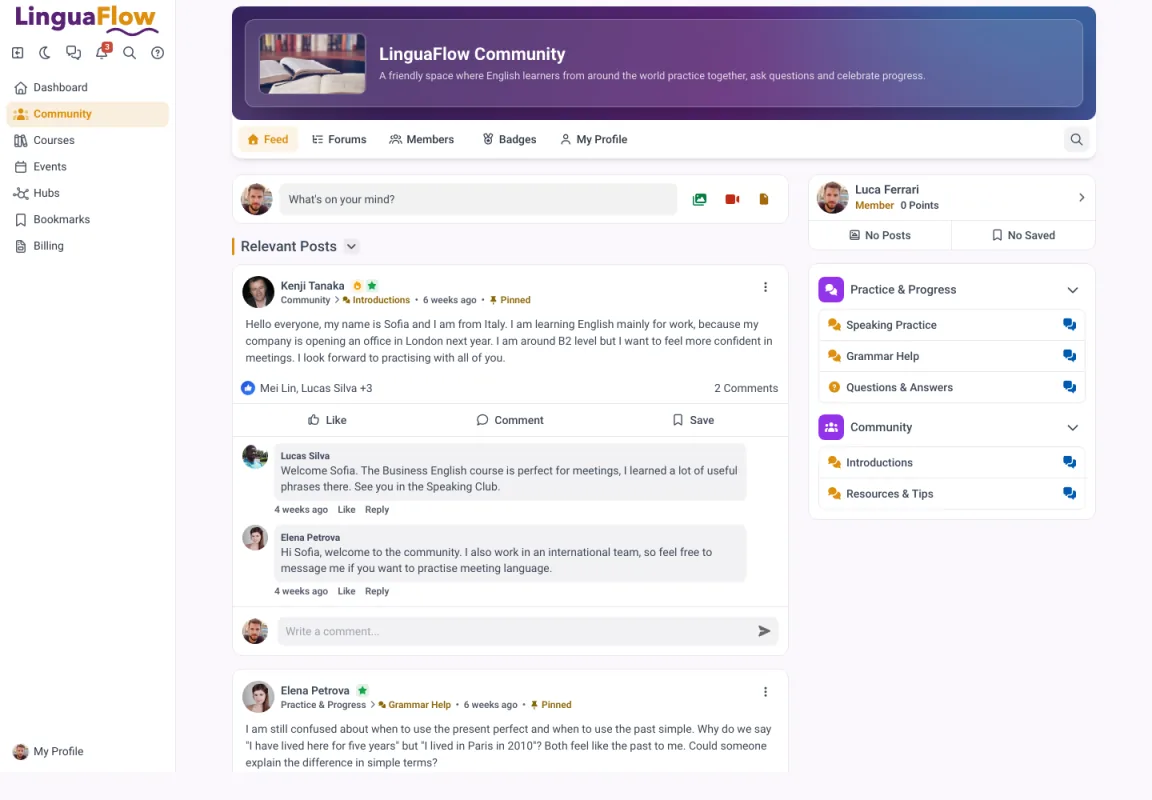
A weekly prompt answered in the target language is the cheapest speaking practice you can run. How the space itself is built is in how to build an online community.
You can structure speaking practice to scale beyond your own hours. Peer practice partners, small conversation groups by level, and regular live sessions or challenges give learners ways to speak without needing one to one time with you for every interaction. Your role shifts to guiding, correcting and encouraging, which lets a single teacher support a much larger group of active learners.
Community also drives the retention that makes selling sustainable. Learners who feel part of a group, who have made friends and conversation partners, stay far longer than those grinding through videos alone. That engagement keeps subscriptions alive and turns happy members into the word of mouth that brings the next wave of students.
Pricing: per course vs. subscription
How you price shapes both your income and how learners relate to your school, and for language courses there are two main models to weigh. The first is selling each course or level as a one off purchase. The second is a subscription that gives ongoing access to your courses and community for a recurring fee. Each fits a different kind of offer, and many successful schools end up blending them.
Per course pricing is simple and familiar: a learner buys the beginner course, and later the intermediate one. It works well when your courses are discrete and substantial, and it gives learners a clear sense of what they are buying. The limitation is that your income resets with each sale, and a learner who finishes one level might drift away before buying the next.
A subscription suits language learning especially well because progress is ongoing and open ended. Learners pay monthly for access to all your courses, the community and live practice, which matches the long, continuous nature of learning a language. For you, that means recurring revenue and a strong incentive to keep learners engaged, since the community and practice are exactly what justify the ongoing fee. Whichever you choose, your platform should handle it cleanly: MemberArea processes payments natively through Stripe, so one off course sales, subscriptions and tiered access all work out of the box, and you can see current plans on the pricing page.
The two models, and what they earn
| Per course | Subscription | Both | |
|---|---|---|---|
| What the learner buys | one level | everything, plus community and practice | a flagship course, then ongoing access |
| Your revenue | resets after every sale | recurring while they stay | a spike, then a base |
| Risk | they drift off before the next level | they cancel when practice dries up | more to explain at checkout |
| Fits when | levels are big and self-contained | practice and community are the product | you already have one strong course |
A quick sense of the second column: 120 subscribers at €29 a month is €3,480 monthly and €41,760 a year, before fees. That is the arithmetic that makes the community worth running, and the pattern is set out in recurring revenue for course creators.
A common, effective approach is to combine the two: sell flagship courses individually while offering a membership that bundles everything plus the community and live practice. That gives learners a low commitment way in and a compelling reason to upgrade to ongoing access. Start with the model that fits your current offer, price it to the real value of fluency, and adjust as you learn how your learners prefer to buy.
Marketing to language learners online
Even the best course needs to be found, and marketing to language learners has some reliable angles. The most powerful is to demonstrate your teaching for free. Short lessons, useful tips, pronunciation guides or quick cultural insights on social platforms or a blog show your expertise and attract exactly the people who want to learn. Language learners actively seek this content, and a sample of your teaching is the best advertisement for your paid courses.
Lead with a specific promise and a clear audience. Helping busy professionals hold a confident conversation in Spanish in ninety days is far more compelling than teaching Spanish in general. The more precisely you name who you help and what result they get, the easier it is for the right learners to recognise that your course is for them, and the easier it is to sell.
Give people a low risk first step. A free mini course, a level placement quiz, or a free challenge inside your community lets prospective learners experience your teaching before they buy, and it builds the email list and trust that turn interest into sales. A week long beginner challenge, for instance, both proves your value and warms people up to enrol when it ends. Which format to pick is compared in lead magnet ideas.
Finally, let your results market for you. Learner progress, testimonials and stories of people who can now hold a conversation are your strongest proof, far more persuasive than any claim you make yourself. Encourage your community to share wins, ask satisfied students for a few words, and consider a referral incentive, since language learners often study alongside friends, partners or colleagues.
Frequently asked questions
Do I need to be a native speaker to sell language courses online? No. What learners value is a teacher who explains clearly, gives useful feedback and helps them progress. Many excellent language teachers are highly fluent non natives who actually understand the learner's journey because they walked it themselves.
How do I provide speaking practice without teaching live all day? Lean on community and structure. Peer conversation partners, small practice groups by level, prompts that ask learners to respond in the target language, and occasional live sessions give plenty of speaking practice without one to one time for every interaction.
Should I sell single courses or a subscription? Both work. One off courses suit discrete, substantial levels, while a subscription fits the ongoing nature of language learning and gives you recurring revenue. Many schools sell flagship courses individually and offer a membership that bundles everything plus the community.
How do I get my first students? Start with free value. Share short lessons and tips where language learners already spend time, offer a free mini course or challenge to build an email list, and invite your earliest students in with a founding offer. Their results then become the proof that attracts the next group.
To sell language courses online well, design for practice as much as knowledge, structure a clear self paced path, build a community that gets learners speaking, price for the real value of fluency, and market by teaching in public. Do that and you build not just a course but an online language school that grows. Launch your online language school on MemberArea and start teaching the world.



Ready to build your membership?
Try it free for 14 days. No credit card, no setup fees. Launch in minutes.
No credit card required · Cancel anytime