
Blog
Marketing Automation for Online Courses: Where to Start
Marketing automation for online course creators: the 5 automations that matter, the tools you need, and how to build and measure them step by step.
Automation and techMost course creators do not lose revenue because their offer is weak, but because they are not present at the right moment. A prospect signs up and never hears from you again. A buyer never finishes the course and goes unnoticed. Marketing automation closes exactly those gaps. With marketing automation for online course creators, you reach every contact automatically at the right time, without writing each message by hand.
This article explains what marketing automation means concretely for course creators, shows the five automations everyone should have running, which tools you need, how to build an automation step by step, and how to measure and improve it.
The best part is that this work is done once. A well built automation keeps running month after month and grows more valuable with every new contact, while you have long since moved on to other things.
The short version: five automations cover the essentials, and the welcome sequence is the only one you need immediately. Automation means behaviour-driven rather than time-driven, so not one newsletter to everyone, but a response to what a single contact just did.
What marketing automation means for online course creators
Marketing automation means letting a system handle recurring marketing tasks by reacting to your contacts' behaviour. Instead of sending every email individually, you define flows once: when someone does this, that happens. After that everything runs automatically, around the clock, for every new contact.
The core is always a trigger and a response. Someone signs up, buys, completes a lesson or goes quiet, and the system responds with the right message or action. That creates the feeling of personal attention even though a machine is working in the background, one that never forgets and never gets tired.
One important difference from a classic newsletter: marketing automation is behaviour-driven, not time-driven. A newsletter goes out to everyone at once, an automation responds to the individual contact and where they are in the journey. That is exactly what makes it so much more effective, because every message arrives at the right moment.
For course creators that is an enormous lever. You cannot personally accompany a hundred people at once, but good marketing automation can. It makes sure every prospect and every student gets the right message at the right time, which visibly lifts sales, completion rates and retention.
The 5 automations that matter most for course creators
You do not have to automate everything at once. These five automations deliver the biggest effect and should be running for every course creator:
| Automation | Trigger | Goal | Metric |
|---|---|---|---|
| Welcome sequence | signup | trust and a first win | open rate on email 1 |
| Sales or launch sequence | launch starts or interest shown | purchase | sales per 100 contacts |
| Onboarding after purchase | purchase completed | first success in the course | share who start lesson one |
| Re-engagement | X days without activity | return to the course | share who come back |
| Feedback and review | course completed | testimonial | replies per completion |
The fourth column is the one most often missing. An automation without a metric that matches its goal cannot be improved. What the individual emails of a sequence look like is in email automation for membership sites.
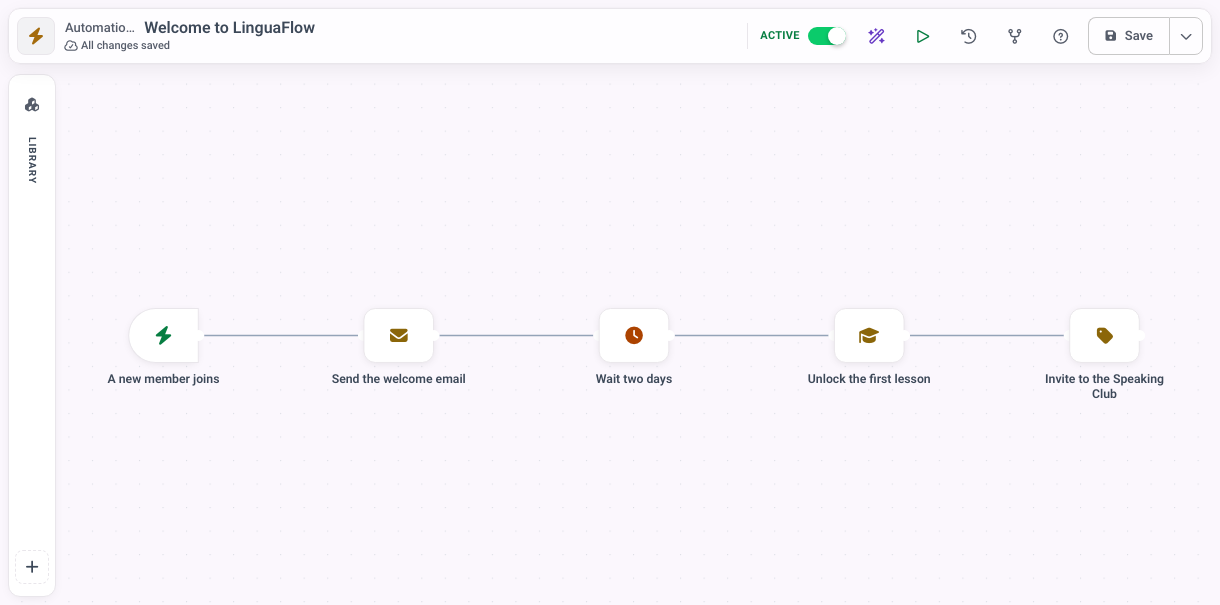
Trigger at the top, steps below, conditions in between: a welcome sequence needs no more than that.
Each of these automations closes a specific gap in your customer journey. Together they accompany a person from first contact to a satisfied graduate who recommends you. Start with the welcome sequence, because it works immediately and is the foundation for everything else.
Sketch the journey first, then build
A practical tip: before building, write down briefly what the ideal journey of a contact looks like with you, from first touch to completion. That sketch instantly shows which automations you are missing and in which order to tackle them, instead of building without a plan.
Behind every one of these automations sits the same idea: reaching people exactly when they are open. The moment right after signing up, the peak of a launch, the first days in the course, these are all windows that close again quickly. An automation uses them reliably, while manual work almost always misses them.
It matters that the automations interlock. Whoever buys is removed from the sales sequence and handed to onboarding. Whoever completes moves into the feedback sequence. That creates one continuous path instead of separate, unconnected emails.
Tools: what you need for this
Marketing automation needs three capabilities at its core: capturing contacts, sending emails by rules, and responding to behaviour. Traditionally many people combine several tools for this, a form tool, an email tool and a connection in between.
That works, but it is expensive, error-prone and laborious to maintain. As soon as data travels between systems, information gets lost or scrambled. Far simpler is a platform where courses, contacts, emails and automations sit together, so every event in a course can trigger an automation directly. The automations page shows what that looks like.
Consider the maintenance effort as well. Several connected tools mean several subscriptions, several logins and several places where something can break. An integrated solution reduces that complexity to one system and one clear picture of your contacts, which helps small teams enormously.
Whatever you choose, make sure your system can respond to real behaviour rather than only sending emails on a fixed schedule. Exactly those behavioural triggers separate a simple newsletter from real marketing automation. More on sending itself is on the email marketing page. If you need to connect external tools that are not part of the platform, Zapier for coaches helps. And how to get enough contacts for any of this is in email marketing for online courses.
Building an automation step by step
Setting up an automation is easier than most people think. Work in four steps. First: define the goal. What should happen at the end, a sale or a completed onboarding? Second: choose the trigger, the event that starts the automation, for example a signup.
Third: plan the steps in between. Which messages come at which intervals, and which conditions apply? Someone who buys should not receive further sales emails, for instance. Fourth: test the automation yourself from start to finish before you switch it on, so no contact receives a wrong or duplicate message.
Every email has to stand on its own
Plan your messages so each one carries value on its own rather than only pushing the sale. An automation that sells and nothing else tires its readers quickly. Alternate between help, story and offer, and your contacts stay attentive while unsubscribes stay low.
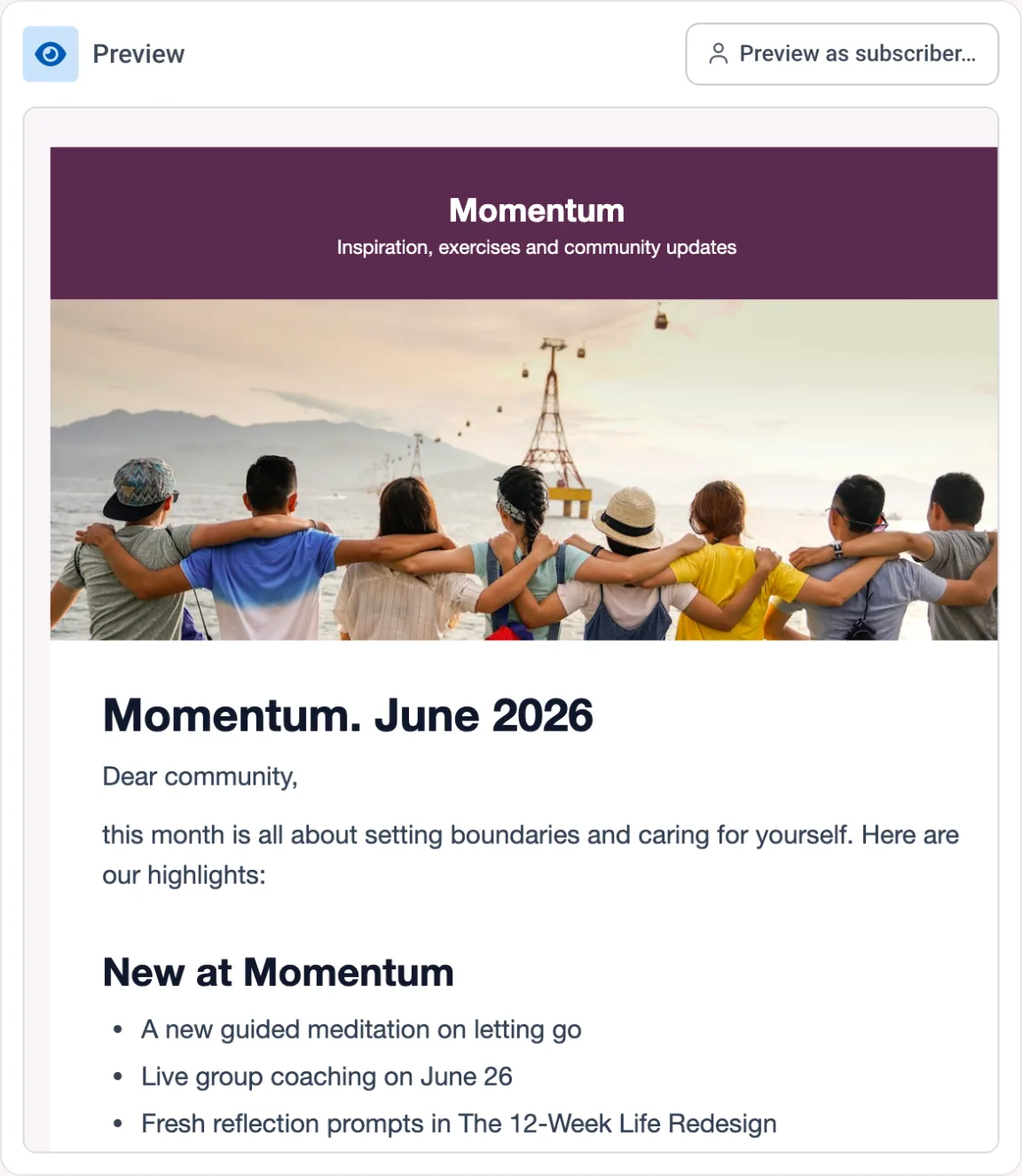
Subject and preheader decide the open rate, the content decides everything after it.
Start deliberately simple. A short welcome sequence of three emails beats a complex branching system you never finish. You can extend any automation later, once it runs and you see how your contacts respond.
Measuring and improving automations
An automation is never finished, it gets better. For that you need the right numbers in view: how many open your emails, how many click, and above all how many take the desired action, meaning buy or complete. Those numbers show you where it stalls.
What to measure your numbers against
To put your own figures in context, industry averages help. Mailchimp publishes them by sector:
| Industry | Open rate | Click rate | Unsubscribes |
|---|---|---|---|
| Education and training | 35.64 percent | 3.02 percent | 0.18 percent |
| All users | 35.63 percent | 2.62 percent | 0.22 percent |
| Non-profit | 40.04 percent | 3.27 percent | 0.18 percent |
| E-commerce | 29.81 percent | 1.74 percent | 0.19 percent |
Source: Mailchimp Email Marketing Benchmarks, retrieved on 14 August 2026. Education and training sits above average on clicks and exactly on it for opens. These are averages across all campaigns, not across automations. Treat them as a rough frame rather than a target: your own figure from last month is the better comparison.
Look specifically at the point where most contacts drop out. Often it is a single email or too long a gap that slows the sequence. Change only one thing at a time so you can see what really works. With the analytics area you can see at a glance which automation performs.
For all the optimising, do not lose sight of the big goal. High open rates are nice, but in the end what counts is whether contacts become buyers and buyers become graduates. Measure the whole path to the actual outcome, not just the first clicks.
Treat your automations as living content. A small improvement to a frequently travelled sequence affects hundreds of contacts and adds up over time to noticeably more revenue, without any new traffic.
Set up automations natively on memberarea.io
For marketing automation to run smoothly for online course creators, courses, contacts, emails and automations should sit in one place. On memberarea.io you set up exactly that: automations that respond directly to events in your courses, from a purchase to a completed lesson to inactivity, without connecting a second tool.
Because everything sits together, real events reliably trigger the right automation, and you see in the same numbers what works. You build your welcome sequence, your onboarding and your re-engagement sequence where your course and your checkout already live. More on the automations page and the plans on the pricing page.
How an onboarding is built in detail is in automating member onboarding, and what the sales sequence before it looks like is in sales funnels for coaches.
Conveniently, you can adjust automations at any time without rebuilding anything. You change a message, move a step or add a condition, and all future contacts immediately go through the improved version.
Set up automations natively on memberarea.io and be present for every contact at the right time, entirely automatically. Try memberarea.io free and build your first automation in minutes.
Frequently asked questions
Do I need a big list for marketing automation to pay off? No. With a small list in particular, automation makes sure no contact is lost. The earlier you start, the more you gain with every new contact.
Is marketing automation impersonal? Quite the opposite. Done well it feels more personal than no follow-up at all. It makes sure everyone gets the right message at the right time, which you could never deliver to everyone by hand.
Where should I start? With the welcome sequence. It works immediately, is quick to build and lays the foundation for every further automation.
How long does setup take? A first welcome sequence is often built in under an hour. More complex sequences need more planning but then run permanently and save you that time many times over.
Conclusion
Marketing automation for online course creators is the way to be present for every prospect and student without cloning yourself. Understand the trigger-and-response principle, set up the five automations that matter, use a system that responds to behaviour, build step by step, and improve based on the numbers.
Start with a single automation that closes a real gap and expand from there. Try memberarea.io free and set up your automations where courses and contacts already live together.



Ready to build your membership?
Try it free for 14 days. No credit card, no setup fees. Launch in minutes.
No credit card required · Cancel anytime