
Blog
AI Tools for Course Creators in 2026: What Actually Works
An honest look at AI tools for course creators: where AI saves time on scripts, quizzes, marketing and learning paths, and what it cannot replace.
Automation and techEvery week brings a new AI tool promising to build your entire course in one click. Most of those promises are hype. But underneath the noise, AI genuinely changes how fast and how well course creators can work, if you know where it helps and where it falls short. This is an honest assessment of AI tools for course creators in 2026: what actually saves time, what is overhyped, and what AI simply cannot do for you.
We will look at AI for scripting and outlines, for quizzes and assessments, for marketing copy and sales pages, and for personalized learning paths, then close with the things AI cannot replace in course creation.
The pace of change makes this hard to navigate. New tools appear constantly, each louder than the last, so the real skill is not finding tools but judging which ones earn a place in your workflow.
The short answer: AI is reliable for outlines, first drafts, quiz questions and repurposing, and unreliable for facts, figures and anything that needs your experience. Use it for the blank page, never for the final word, and check every number it hands you.
What AI tools mean for course creators today
Before the specific use cases, one principle matters more than any single tool: AI is a multiplier of your expertise, not a substitute for it. Used well, AI tools for course creators take the slow, repetitive parts off your plate so you can spend more time on the things only you can do. Used badly, they produce generic, soulless content that no one wants.
That framing decides whether AI helps or hurts. The creators who win with AI treat its output as a first draft, a starting point they shape with their own knowledge, stories and voice. The ones who lose hand the whole job to a machine and ship interchangeable filler. The same tool produces both outcomes; the difference is how you use it.
Where AI actually saves time
A rough sense of the trade is more useful than a list of tools. Take a ten lesson course where scripting a lesson takes you about 45 minutes from scratch, so roughly 7.5 hours of writing:
| Task | AI does | You still do | Worth it |
|---|---|---|---|
| Course outline | a structured first pass in a minute | reorder it around what your students actually struggle with | yes, every time |
| Lesson first draft | scaffolding you can react to | replace the generic parts with your examples | yes, if you rewrite |
| Quiz questions | ten questions from a lesson text | check each one for accuracy and difficulty | yes, with review |
| Sales copy | variations to react to | rewrite in your voice | partly |
| Facts, figures, sources | confident sounding text | verify all of it | no, do it yourself |
The 45 minutes is a working estimate, not a measurement. The pattern is what matters: AI shortens the parts where a blank page is the obstacle, and adds work everywhere accuracy is the obstacle.
Keep that lens as you read. For each use case below, the question is not can AI do this but does AI doing this free me to do better work. When the answer is yes, lean in. When it is no, skip the hype and keep your hands on the wheel.
AI for course scripting and outlines
This is where AI saves the most time, and it genuinely works. Instead of staring at a blank page, you can ask AI for an outline, draft rough versions of lessons, or simplify a complicated explanation. You stay the expert; AI is your fast drafting assistant that never gets tired.
The right approach is to use AI as a starting point, not a finished product. It does not know your specific knowledge, your examples or your voice. Take its draft as scaffolding and fill it with your experience and stories. Give it clear instructions, who the lesson is for and what it should achieve, and the draft gets dramatically more useful. This is one of the most reliable AI tools for course creators.
The prompt decides the draft
AI also shines at the parts many creators dread: a punchy introduction, a clear summary, practice exercises or trimming a bloated paragraph. Handing those to AI and refining the result is often the fastest way to a finished, polished lesson.
AI for quiz and assessment generation
Good assessments matter but take time to write. AI is excellent here. From your lesson text, it generates relevant questions in seconds, from multiple choice to open prompts. That lets you add a meaningful check to every lesson without the usual effort.
| Question type | What AI gets right | What you have to fix |
|---|---|---|
| Multiple choice | plausible wrong answers, fast | distractors that are accidentally correct |
| True or false | quick coverage of definitions | statements that are true only in some contexts |
| Open question | useful prompts for reflection | a model answer, because AI will not grade your students |
| Scenario or case | a workable setup | the detail that makes it match your field |
Reviewing four generated questions takes about as long as writing one from scratch, which is where the saving comes from.
The catch, and it is real, is that you must review what it produces. AI can write questions that are too easy, too hard or subtly misleading. A quick pass and small edits turn the draft into a genuinely good assessment. The combination of AI speed and your judgment is ideal, and it is a clear win rather than hype.
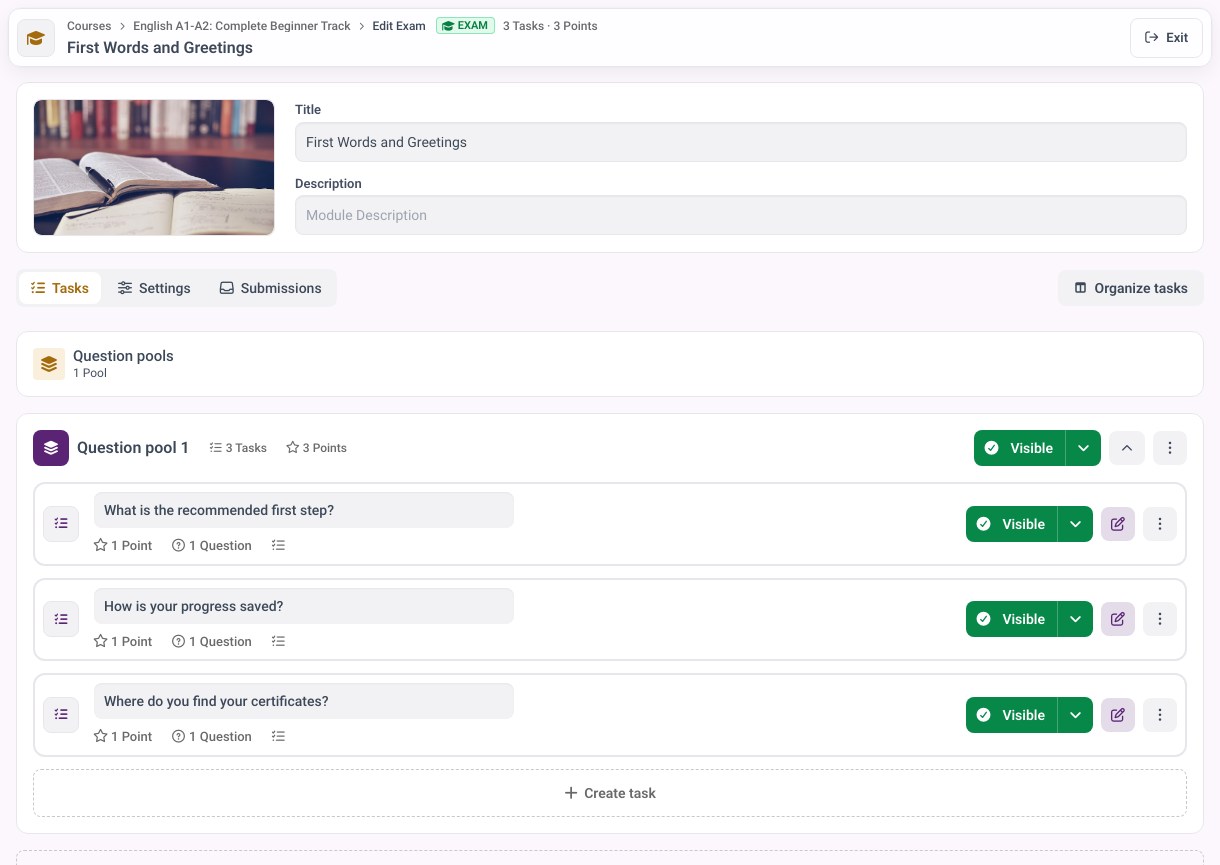
An AI draft becomes a real assessment at the point where a human checks the answer key.
You can also use AI to vary question types and difficulty across a course, keeping assessments fresh rather than repetitive. Just keep a human eye on accuracy, especially for anything technical where a plausible-sounding wrong answer can slip through.
AI for marketing copy and sales pages
AI is a strong helper for marketing, with one caveat. It drafts sales copy, emails, social posts and descriptions quickly, which is a gift if writing does not come easily to you. For overcoming the blank page and generating variations to test, it is genuinely useful.
The caveat is voice. A generic AI sales page sounds like everyone else's, which is the opposite of what good marketing needs. Use AI to get past the blank page, then rewrite in your own voice so the copy sounds like you. Treated that way, AI speeds up your marketing without flattening its personality. Skip any tool that promises hands-off, fully automated copy that converts; that part is overhyped.
AI is also handy for repurposing. Feed it one lesson and ask for a social post, a newsletter blurb and a short summary, then polish each. That stretches a single piece of work across several channels without writing each from scratch. The structure a sales page needs before any copy goes into it is laid out in sales page for an online course.
Does AI written copy hurt your search rankings
Not by itself. Google states that its ranking systems aim to reward original, high quality content that shows expertise, experience, authoritativeness and trustworthiness, however it is produced, and that using automation to generate content primarily to manipulate rankings is what breaks its spam policies (Google Search and AI content). In practice the rule is the same as the one in this article: publish it because it is good, not because it was cheap to produce.
AI for personalized learning paths
This is the most promising and least mature use case. In theory, AI can read a learner's behavior, spot where they struggle and recommend the right content or review. Done well, that lifts completion rates because students feel guided rather than lost. How AI-driven features look is shown on the AI agents page.
Be realistic about the current state. Simple, useful versions exist today, like recommending the next lesson or flagging a topic to revisit. Truly adaptive, individualized tutoring is still early and often overpromised. Use the practical pieces that genuinely help now, and treat the grander claims with healthy skepticism until they prove themselves.
Even modest personalization helps retention. A nudge toward the right next step, or a gentle reminder to revisit a tricky topic, makes learners feel guided. Start with these simple wins rather than waiting for fully adaptive systems that are still maturing. Which lever moves completion the most is covered in online course completion rates, and the mechanics of releasing content on a path are in drip course content.
What AI cannot replace in course creation
For all its usefulness, AI has hard limits you must respect. First, it can invent things. AI writes convincingly but not always correctly, so never publish facts, figures or sources from AI without checking them. With a course, your credibility is on the line.
Second, AI does not have your experience. The value of your course lives in your unique knowledge, your stories and your perspective. AI can imitate that but not replace it. A course built purely from AI text delivers interchangeable content that no one truly needs, and learners feel the difference quickly.
What the law expects of you
The EU AI Act sets transparency duties in Article 50. Providers of systems that generate synthetic text, audio, image or video must mark the output as machine readable and detectable, and deployers who publish AI generated text to inform the public on matters of public interest must disclose it, unless the content went through human review with someone taking editorial responsibility for it (AI Act, Article 50). A paid course is rarely public interest publishing, so the disclosure duty seldom bites. The exemption is the interesting part: human review with editorial responsibility is exactly what the law treats as sufficient, and exactly what your students are paying for.
Be transparent, too. Where it matters, do not hide that you used AI as a tool, and never pass off invented detail as fact. Your audience forgives a clearly human, occasionally imperfect course far sooner than polished-sounding content that turns out to be wrong.
Third, AI cannot build trust or relationship, which is the heart of why people buy from a specific creator. It cannot care about a student's outcome the way you do. Used right, AI tools for course creators make you faster and free you for exactly this human work. Used as a replacement, they produce mass-market filler. The whole difference is whether AI is your tool or your stand-in.
Build your AI-enhanced courses on memberarea.io
For AI to actually save you time, course creation, content and marketing should live in one place. On memberarea.io you build your courses, add quizzes and interactive elements and connect them to your marketing, so you drop AI drafts straight where the course is made. You skip the constant switching between a dozen tools. Where a step genuinely belongs in another system, automating an online course with Zapier shows how to connect it.
Because everything is connected, you move from an AI draft to a finished, sellable course with assessments and marketing far faster.
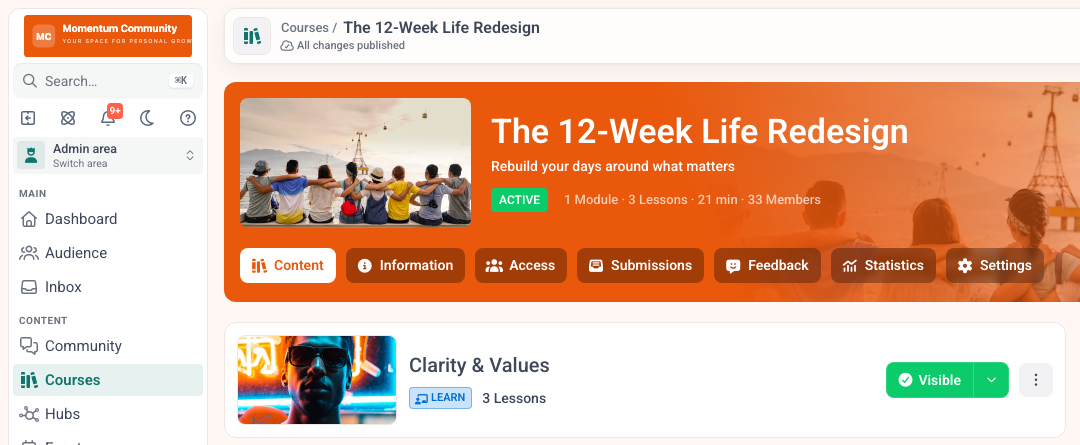
An AI outline is worth something once it becomes modules and lessons someone can work through. The full process is in how to create an online course.
Learn more about building courses on the courses page, about AI features on the AI agents page, and see the plans on the pricing page.
Build your AI-enhanced courses on memberarea.io and use AI as a multiplier of your expertise, not a replacement for it. Try memberarea.io for free and ship your next course faster.
Frequently asked questions
Will AI replace course creators? No. AI removes busywork and speeds up drafts, but your knowledge, experience and voice stay irreplaceable. The best courses come from combining both.
Can I publish AI-generated content as is? Only after careful review. AI can make mistakes and invent facts. Treat its output as a draft you check and refine with your expertise before it goes live.
Which AI use case should I start with? Scripting and outlines, or quiz generation. Both save real time immediately with low risk, so you feel the benefit fast without overhauling how you work.
Conclusion
The honest verdict on AI tools for course creators in 2026: brilliant for outlines, drafts, quizzes and marketing variations, genuinely promising for simple personalization, and no substitute for your expertise, your voice or your fact-checking. Use AI to handle the slow parts and free yourself for the work only you can do, and ignore any tool that promises to do the whole job for you.
Pick one use case where AI helps you today and try it on your next lesson. Try memberarea.io for free and build your AI-enhanced courses where content and marketing already live.



Ready to build your membership?
Try it free for 14 days. No credit card, no setup fees. Launch in minutes.
No credit card required · Cancel anytime